REVIEW · E-BIKES
Budapest: Private Fahrradtour – optional mit E-Bikes
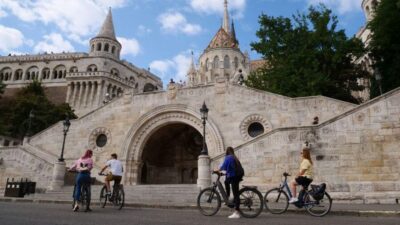
Budapest opens up beautifully on two wheels. This private ride links the city’s grand avenues, thermal baths, historic bridges, Jewish Quarter, Parliament, and Danube riverfront in one efficient outing. You can choose a standard bicycle or an optional e-bike, and your own group of up to six rides with a guide in English.
I especially like the central start point near Gozsdu Udvar and the way the route covers both Pest and Buda. I also like the strong sightseeing value: you pass many famous places without spending the day joining separate walking tours or figuring out Budapest’s complicated layout yourself.
The main drawback is simple: this is a sightseeing ride, not a museum tour. You will see the Opera, Parliament, baths, synagogue, and churches from outside, but no entry tickets are included. The tour also requires moderate fitness and is not designed for beginners.
In This Review
- Key Points Before You Book
- Starting Near Gozsdu Udvar
- Andrássy Avenue and the Opera House
- Heroes’ Square and City Park
- Liszt Square, Király Street, and the Jewish Quarter
- St. Stephen’s Basilica and Szabadság Square
- Parliament and the Best Danube Views
- Chain Bridge, Castle Garden, and the Buda Riverbank
- Rudas Baths, Gellért Baths, and Liberty Bridge
- Fővám Square, the Market Hall, and the National Museum
- What the Price Means
- How Long the Ride Really Takes
- Who Will Enjoy This Ride Most?
- Should You Book the Budapest Private Bike Tour?
- FAQ
- Where does the Budapest private bike tour start?
- What time does the tour begin?
- Where does the tour finish?
- How long does the tour last?
- How many people can join the private tour?
- Is the tour offered in English?
- Are e-bikes available?
- Are helmets provided?
- Are attraction admission tickets included?
- Is the tour suitable for beginners?
Key Points Before You Book
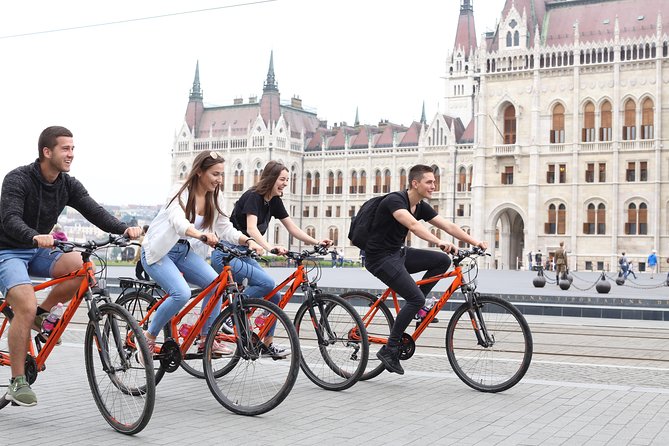
- Private group of up to six: You ride only with your own party, which makes it easier to ask questions and adjust the pace.
- A full Budapest overview: The route includes Andrássy Avenue, Heroes’ Square, City Park, Parliament, the Danube Banks, Gellért Hill, and the Great Synagogue.
- Regular bikes or e-bikes: E-bikes can make the longer route more comfortable, especially for riders who do not want every hill to become a personal debate.
- A two-to-four-hour ride: The exact length depends on the pace, stops, and selected bike option.
- Outside visits only: You do not enter the Opera, House of Terror, baths, Parliament, St. Stephen’s Basilica, or the Great Synagogue.
- Easy central meeting point: Start and finish at Madách Imre út 12, near Gozsdu Udvar and Café Hivatal, at 10:30 a.m.
Starting Near Gozsdu Udvar
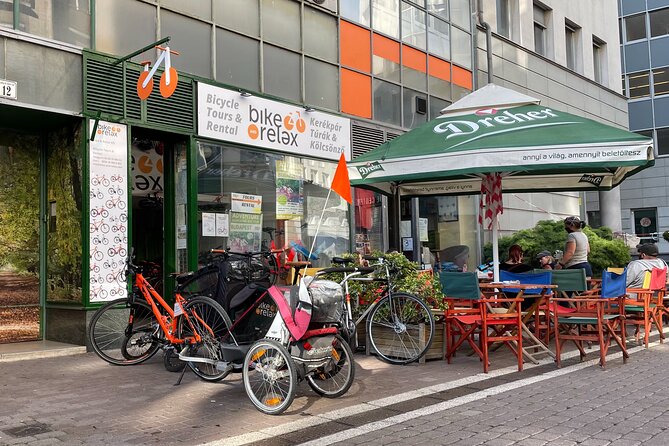
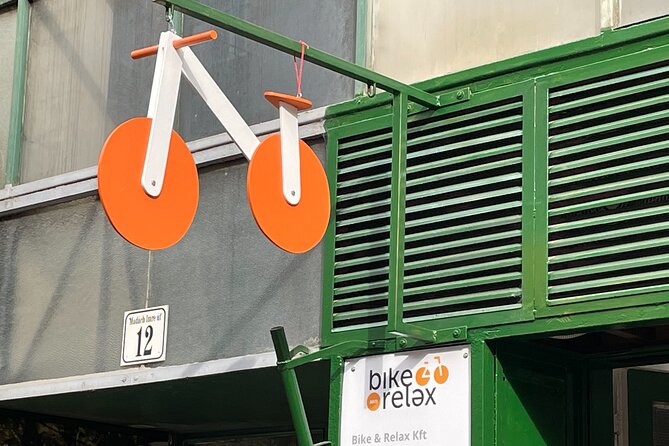
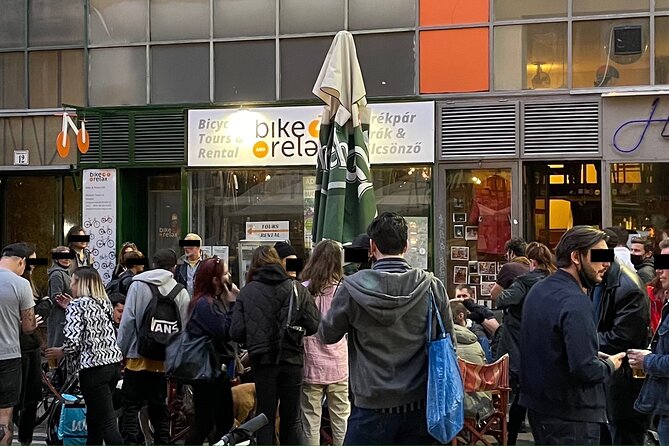
The tour begins at Madách Imre út 12 in the seventh district. This is the rear section of Madách Square, linking the square with Gozsdu Court. Look for Café Hivatal as a useful landmark.
That location works well. You are close to the Jewish Quarter, Elizabeth Square, Király Street, and several major downtown sights. Starting here means you can reach the historic core quickly without first spending time getting out of a distant rental shop.
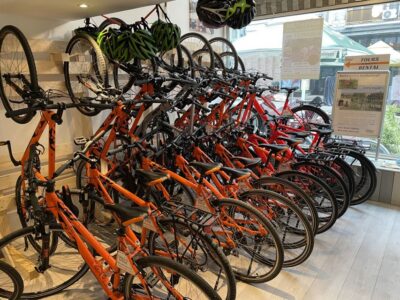
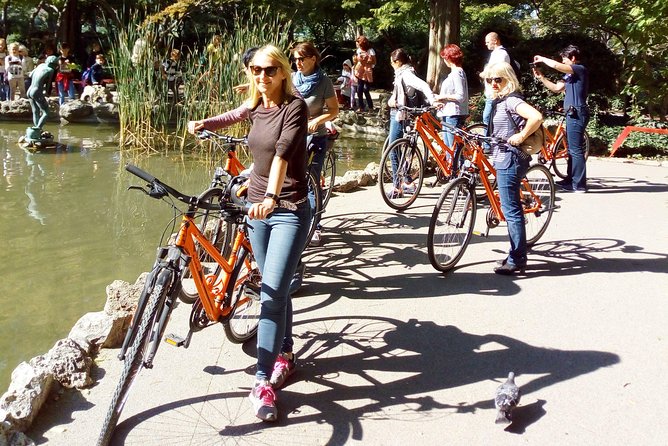
The tour includes a bicycle or e-bike, a bottle of water, a guide, and a helmet if you want one. The experience is private, so your group is not mixed with strangers. That matters if one rider needs more explanation, a short pause, or help choosing between a regular bike and an e-bike.
The ride is offered in English. Children must be accompanied by adults. You should have a moderate level of fitness, and the tour is not suitable for beginners or anyone weighing more than 110 kilograms. Those conditions are worth taking seriously, especially because the route crosses busy central areas and covers a considerable part of the city.
More bike tours in Budapest:
- Budapest: Grand Sightseeing Bike Tour
★ 4.8 · 984 reviews - Budapest Highlights Bike Tour
★ 5.0 · 770 reviews - Budapest: Guided City Discovery Bike Tour
★ 4.7 · 702 reviews
Andrássy Avenue and the Opera House
The first major stretch leads toward the Hungarian State Opera on Andrássy Avenue. The Opera House was designed by Miklós Ybl and is one of Budapest’s finest late nineteenth-century buildings. Your guide explains the architectural styles along the avenue and points out the historic M1 metro, one of the city’s distinctive transport landmarks.
You will not enter the Opera, so this stop is about the exterior and the setting. That is still worthwhile because Andrássy Avenue is not just a grand street. It connects central Budapest with Heroes’ Square and City Park, forming one of the city’s major ceremonial routes.
The ride continues along the avenue past Nagymező Street, often called Budapest’s Broadway, and Liszt Ferenc Square. You also pass the Ring Roads and the House of Terror Museum.
The House of Terror occupies a former Gestapo headquarters and later communist prison. A section of the Berlin Wall is displayed outside. You stop for only about five minutes and do not enter, so treat this as a historical signpost rather than a museum visit. If the subject interests you, mark it for a separate visit later.
Heroes’ Square and City Park
Heroes’ Square gives you one of the clearest visual introductions to Hungary’s national story. Built for the country’s 1,000-year anniversary in 1896, the monument presents major figures from Hungarian history, from King Stephen to revolutionary leader Lajos Kossuth.
The square can feel like a history lesson compressed into one open space. Your guide helps put the statues and dates into context, which is useful because the monument can otherwise seem like a large collection of serious-looking people on pedestals.
From there, you ride into Városliget, or City Park. The park covers about one square kilometer in the middle of Budapest and is used for leisure, recreation, and sport. It has been undergoing redesign work, so parts of it may look unfinished or altered. Still, it provides a welcome change from the formal avenue.
Vajdahunyad Castle is one of the park’s most entertaining sights. It looks medieval, but it was built as a temporary exhibition structure for the 1896 celebrations and later rebuilt in permanent materials. The design borrows from several architectural periods, which explains its slightly theatrical appearance. Your guide also points out the statue of Anonymous, a popular stop for photographs.
The route then passes the Széchenyi Baths, Budapest’s largest spa complex. The building represents the city’s long bathing tradition, shaped by Roman and Ottoman influences and continued in modern Budapest. You will see the exterior only, but it is enough to understand why thermal bathing is such a central part of the city’s identity.
Liszt Square, Király Street, and the Jewish Quarter
Back toward the center, Liszt Ferenc Square brings the route into a more contemporary part of Budapest. The Music Academy honors the famous composer Franz Liszt, and the building shows the ornate Secession style used in Hungary. The square is lined with restaurants and terraces, making it a practical place to note for a later meal or drink.
Király Street leads through the Jewish Quarter. Your guide discusses ruin pubs and takes you near Gozsdu Court, a passageway filled with shops, food venues, and nightlife. This section gives you a different sense of Budapest from the grand monuments. It is less formal and more social, with traces of the city’s changing urban life packed into a few blocks.
Elizabeth Square follows. It is a major downtown meeting point, with the Aquarium, an underground bar, and the Fröccs Terrace. A fröccs is a Hungarian drink made with white wine and soda water. The stop is brief, but it gives you a useful local detail to look for later.
A completely different kind of day:
- Budapest: City Highlights Cruise with Welcome Drink
★ 4.6 · 35,610 reviews - Budapest: Unlimited Prosecco, Beer and Aperol Spritz Cruise
★ 4.8 · 25,310 reviews - Budapest: Széchenyi Spa Day Ticket with Optional Upgrades
★ 4.3 · 23,911 reviews - Budapest: Nighttime or Daytime Sightseeing Cruise
★ 4.2 · 21,062 reviews
St. Stephen’s Basilica and Szabadság Square
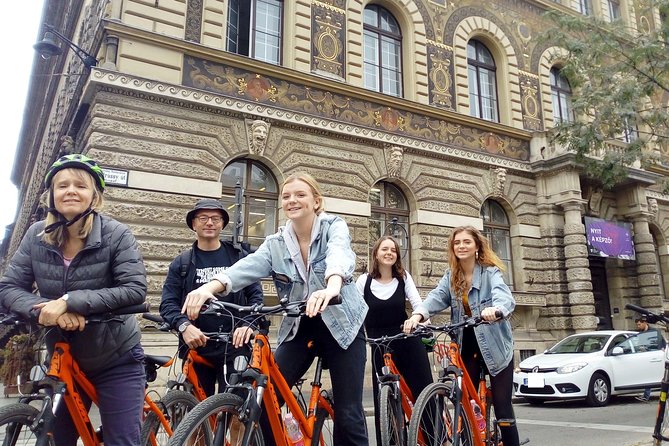
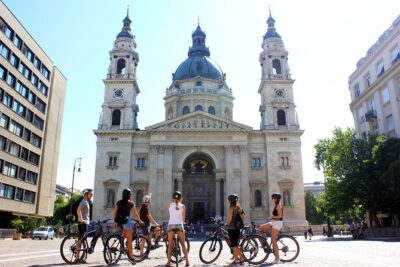
St. Stephen’s Basilica is Budapest’s largest Catholic church. Its most unusual feature is the preserved right hand of St. Stephen, displayed under glass. The church has been carefully renovated and is one of downtown’s key landmarks.
Again, there is no interior visit. You get a short exterior stop, so you should plan a separate visit if you want to see the dome or the relic.
The next stop, Szabadság Square, adds a more difficult chapter of Hungarian history. The square combines financial institutions with memorials connected to the Second World War and the Holocaust. At least one monument is deliberately controversial, and the area includes ironic responses to official historical messages.
This is one of the route’s most valuable stops because it shows that Budapest’s past is not presented in one neat, agreed-upon version. A guide can explain the competing symbols far better than a quick photograph can.
Parliament and the Best Danube Views
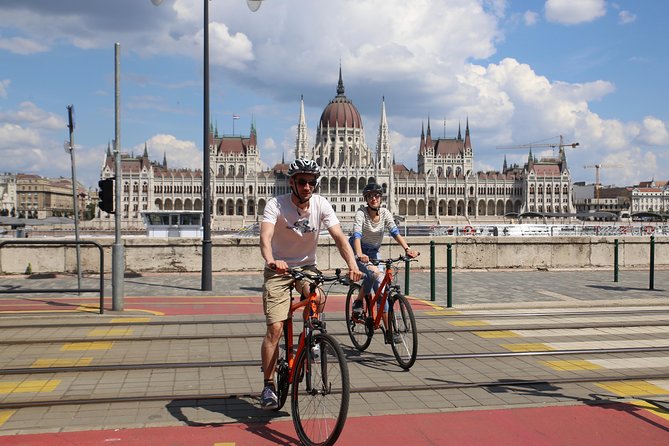
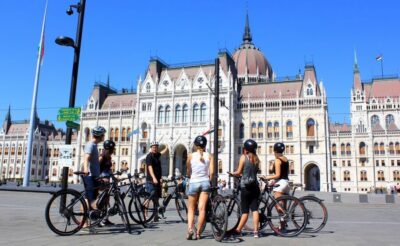
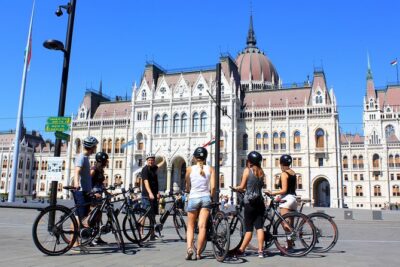
The Hungarian Parliament Building is one of Budapest’s essential sights. It sits on the Pest riverbank and is still an active government building. The tour does not include entry, but riding around the building gives you views toward the Danube and the Buda hills.
This is one of the places where a bicycle tour saves time. Parliament’s riverfront setting is spread out, and you can reach the best exterior viewpoints without arranging separate transport. Bring a camera, but keep listening too. The building looks spectacular, yet the guide’s explanation of its role and setting adds much more than a quick stop on a sightseeing bus.
The route crosses Margaret Bridge, historically the second bridge over the Danube. It has a bicycle path and provides access to Margaret Island. The tour does not list a visit to the island, but the bridge crossing gives you broad views of the river and both sides of the city.
On the Buda side, Batthyány Square is a superb place to look back at Parliament. The square contains Baroque and Rococo buildings and offers one of the clearest frontal views of the Parliament across the water. If you care about photographs, this is a stop to remember.
Chain Bridge, Castle Garden, and the Buda Riverbank
Clark Ádám Square sits beside the Chain Bridge and marks Hungary’s zero-mile point. It is also the base of the Buda side of the famous bridge, completed in 1849 under the direction of Adam Clark.
The Széchenyi Chain Bridge was the first permanent bridge to connect Buda and Pest. Its stone towers and suspended chains have made it one of Budapest’s defining sights. The stop is short, but the bridge deserves a pause because it explains how the two historic halves of the city became one capital.
The ride continues by Castle Garden, another work connected with Miklós Ybl. Its late nineteenth-century style contrasts with the medieval sections of the former royal castle visible above. An elevator leads from the garden toward the Royal Palace, though you do not take a palace tour as part of this experience.
You then pass beneath the Erzsébet Bridge, named after Queen Elisabeth, known in Hungary as Sissi. The route follows the riverbank toward Gellért Hill, where you see the statue of St. Gerard and hear the sad story linked with him.
This section is especially good for understanding Budapest’s geography. You are close to the water, with Buda rising beside you and Pest spread across the river. The route gives you the city in one continuous picture rather than as isolated attractions.
Rudas Baths, Gellért Baths, and Liberty Bridge
Rudas Baths are among Budapest’s best-known Turkish baths. The complex began in the Ottoman period, was rebuilt in the nineteenth century, and has since gained modern additions such as a rooftop pool, restaurant, and bar. The bicycle stop is brief and exterior-only.
Gellért Thermal Bath offers a different architectural mood. The building uses an ornate Art Deco style and contains both a public bath and a hotel. It overlooks the Danube near Liberty Bridge, creating one of the most attractive combinations of building, river, and bridge in the city.
You remain on the riverbank instead of climbing Gellért Hill or visiting the Citadella. That is a practical choice for a tour covering so much ground, but it means you will not get the hilltop views from this ride.
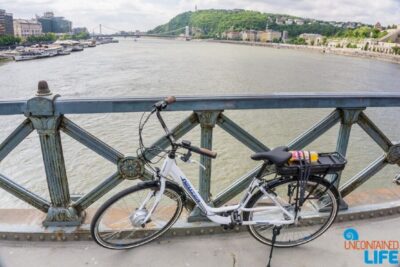
Liberty Bridge is a favorite Budapest meeting place, especially around sunset. Its green iron structure is a fine example of nineteenth-century engineering, and the bridge connects the Gellért Baths area with the Pest side. You cross it by bicycle, then continue to Fővám Square.
Fővám Square, the Market Hall, and the National Museum
Fővám Square sits beside the University of Economics, housed in what was originally Budapest’s main customs office. That explains the square’s name, which refers to the former customs function.
The nearby Grand Market Hall is still used by local shoppers, though it also sells plenty of items aimed at visitors. Its steel construction is worth seeing even if you do not stop to shop. The route passes the building rather than including a dedicated market visit, so return later if you want paprika, food, or a closer look inside.
Continuing along the Ring Road, you pass the Hungarian National Museum. It was the first major public building outside the old downtown area and helped encourage wealthy families to build palaces nearby. The museum also played an important role in the development of Hungarian national identity during the nineteenth century.
The final major stop is the Great, or Central, Synagogue at the edge of the Jewish Quarter. Its Moorish-style exterior is striking, and its location links the route back to the district where the tour began. Entry is not included, so plan another visit if you want to see the interior, memorial garden, and museum.
What the Price Means
The private tour costs $435.54 per group of up to six people. That price looks high for a bike ride if you are traveling alone or as a couple. Split six ways, however, it works out to about $72.59 per person, before any optional tip, and includes the guide, bicycle or e-bike, helmet, and water.
The value comes from the amount of ground covered and the private format. You see major sights in Pest, cross the Danube, ride along the Buda riverbank, and return through the market and Jewish Quarter. Public transport can take you near many of these places, but it will not give you the same continuous route or live explanations.
For two people, the cost is harder to justify unless you value a private guide and want a quick orientation at the start of your stay. For four to six people, the price becomes much more reasonable. It is also a good fit if you have only one full day for sightseeing and want help deciding which places deserve a longer visit later.
The ride has received strong praise for its equipment and guiding. Eszter, one named guide, was described as friendly, informative, and careful about safety. The bicycles were reported to be in excellent condition and easy to use. A separate rental experience with Thomas and his team also highlighted comfortable bikes, helpful advice, and good value.
That praise points to the company’s strongest feature: you are not simply handed a bicycle and sent into traffic. The guide and equipment are a meaningful part of what you are paying for.
How Long the Ride Really Takes
The advertised duration is about two to four hours. That is a wide range, but it makes sense for a private tour with many short stops. A faster group may keep moving, while a group asking more questions or pausing for photographs may use more time.
You should not expect a long visit at every location. Many stops last five or ten minutes, and several are pass-by points. The route is designed to show you the city’s structure and major sights, not to provide full museum visits.
I would schedule it early in your Budapest stay. The route gives you a useful map of the city, and you can return later to the Opera, House of Terror, baths, Parliament, Basilica, market, or synagogue. One rider specifically found it useful as a first Budapest activity because it helped identify places worth revisiting.
The tour begins at 10:30 a.m. and finishes back at the same meeting point. It requires good weather. If poor weather cancels the ride, you are offered another date or a full refund. You can cancel for a full refund up to 24 hours before the start time.
Who Will Enjoy This Ride Most?
I would recommend it to families with older children, couples, friends, and small groups who want a private introduction to Budapest. It is particularly useful for people who prefer active sightseeing and do not want to spend several hours on foot.
An e-bike is a sensible choice if you are unsure about your stamina. The route includes long stretches and some city riding, and the e-bike option can make the experience less tiring. Still, an e-bike does not turn the tour into a beginner lesson. The experience is not suitable for beginners, and you need enough confidence to ride in an urban setting.
You should choose another activity if your priority is entering monuments, spending time in museums, or taking a slow architectural walk. This tour gives you breadth rather than depth. Its strength is the big picture.
Should You Book the Budapest Private Bike Tour?
Book it if you want a private, active orientation to Budapest and your group can share the cost. The route covers an impressive number of major sights, the central meeting point is convenient, and the option of an e-bike makes the long ride more approachable.
I would choose the e-bike for mixed-ability groups and the regular bicycle only if everyone is comfortable riding for several hours. Go early in your visit, listen carefully at Szabadság Square and Parliament, and make a note of the places you want to revisit.
Skip it if you are a complete cycling beginner, need indoor attractions, or dislike a quick outside view of major monuments. For the right group, though, this is an efficient way to get your bearings fast and see how Budapest’s two sides fit together.
FAQ
Where does the Budapest private bike tour start?
It starts at Budapest, Madách Imre út 12, 1075 Hungary. The location is near Gozsdu Udvar and Café Hivatal.
What time does the tour begin?
The scheduled start time is 10:30 a.m.
Where does the tour finish?
The activity ends back at the original meeting point on Madách Imre út.
How long does the tour last?
The tour lasts approximately two to four hours.
How many people can join the private tour?
Up to six people can participate in one private group.
Is the tour offered in English?
Yes. The tour is offered in English.
Are e-bikes available?
Yes. You can choose a regular bicycle or an e-bike.
Are helmets provided?
A bicycle helmet is included, but wearing one is not mandatory.
Are attraction admission tickets included?
No. Entry tickets to attractions are not included. The route views the Opera, House of Terror Museum, baths, St. Stephen’s Basilica, Parliament, Rudas Baths, Gellért Baths, and Great Synagogue from outside.
Is the tour suitable for beginners?
No. The tour is not suitable for beginners and requires moderate physical fitness. Children must be accompanied by adults, and the tour is not suitable for participants weighing more than 110 kilograms.
Just added in Budapest
- Budapest: Private Walking Tour with a Local Guide★ 3.6 · 6 reviews
- Budapest: Danube River Views Bike Ride★ 4.8 · 23 reviews
- Budapest: City Bike Tour with Coffee Stop★ 5.0 · 37 reviews
- From Budapest: Guided Tour of Eger with Wine Tasting★ 4.5 · 6 reviews
- Walk to recent and aged spiritual sanctuaries near Budapest★ 5.0 · 5 reviews
- Walking consultancy with alternative psychologist and author★ 5.0 · 2 reviews
- Budapest: Guided Tour of the Parliament Building in Spanish★ 4.6 · 1,240 reviews
- Budapest: 3-Hour Trabant Sightseeing Tour★ 4.7 · 28 reviews