REVIEW · BUDAPEST TOURS
Hungary today: a no-taboo conversation
Budapest gets more interesting when you ask hard questions. This 90-minute conversation at Bambi Café offers a direct look at Hungary’s shift from Communism to democracy and its present-day political life. I like the small maximum of six people, which gives you room to speak rather than sit quietly in a crowd, and I like the open format, where your own questions can shape the discussion.
I also appreciate the setting: Bambi Café has changed little since the 1970s, so the meeting place fits the subject. The main consideration is that this is not a sightseeing tour with major landmarks or a neutral academic lecture. You are paying for access to personal opinions and candid conversation, and that may not suit anyone wanting a tightly scripted introduction.
In This Review
- Key points about this Budapest conversation
- Why this experience gives you a different Budapest
- Bambi Café at Frankel Leó út 2-4
- The first part: Hungary after Communism
- The second part: a no-taboo conversation
- Daniel, Raymond, and the value of a personal point of view
- Is $40.52 a fair price for 90 minutes?
- Who will enjoy this most
- How to prepare for a better conversation
- Timing, meeting point, and cancellation
- My final call: book it for questions, not landmarks
- FAQ
- Where does the experience begin?
- What time does the conversation start?
- How long does the experience last?
- How many people can join?
- Does the experience include a guided city walk?
- Can I cancel for a full refund?
Key points about this Budapest conversation

- A 90-minute discussion at Bambi Café focuses on Hungary since the end of Communism.
- Politics, economics, social change, and the future are all fair subjects.
- The group is limited to six people, allowing for a real exchange rather than a one-way talk.
- Daniel received especially warm praise for his friendly and well-informed approach.
- The format can follow your questions, though an introduction is provided if you arrive without a set topic.
- The $40.52 price is reasonable for a small, personal discussion, but high if you expect a conventional city tour.
Why this experience gives you a different Budapest
Many Budapest tours concentrate on grand buildings, royal stories, thermal baths, and the city’s café culture. Those are worthwhile, but they can leave you with little sense of how Hungary works today. This experience takes a different route. It asks you to sit down and talk about the country’s recent past and present with someone who lives there.
The focus begins with the transition from Communism to democracy, then moves into the idea of an illiberal democracy and the political changes of recent years. Economics, social conditions, personal opinions, possible reforms, and Hungary’s uncertain future may all enter the conversation.
That makes this especially useful if you have already seen the main sights or have a basic grasp of twentieth-century Hungarian history. I would not choose it as my only introduction to Budapest, since it does not provide a broad walk around town. But it can add the missing human explanation after you have seen the Parliament, Castle District, or former Communist-era sites.
You are not simply collecting dates. You are trying to understand how ordinary life, politics, and national identity connect. That can be harder to find on a standard sightseeing route.
More things to do in Budapest:
- Budapest: City Highlights Cruise with Welcome Drink
★ 4.6 · 35,610 reviews - Budapest: Unlimited Prosecco, Beer and Aperol Spritz Cruise
★ 4.8 · 25,310 reviews - Budapest: Széchenyi Spa Day Ticket with Optional Upgrades
★ 4.3 · 23,911 reviews
Bambi Café at Frankel Leó út 2-4
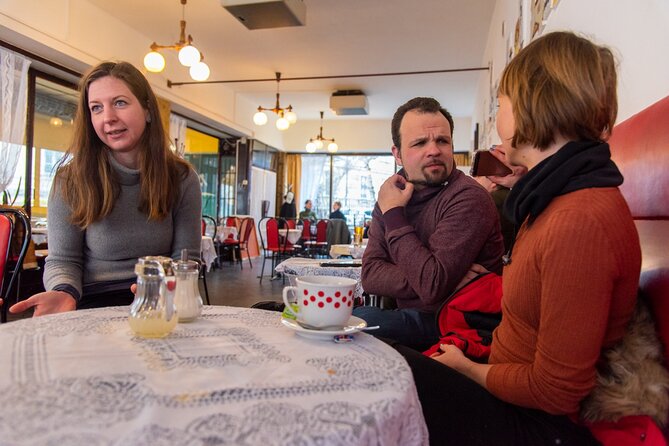
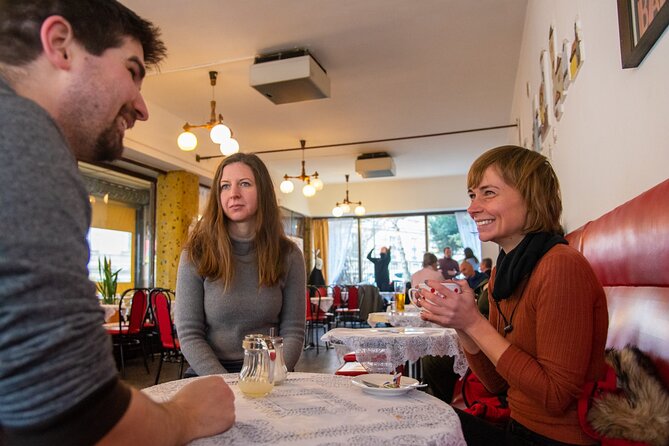
The meeting place is Bambi Café, at Frankel Leó út 2-4 in Budapest’s District II. The café is described as a cult spot that has changed very little since the 1970s. That detail matters because the setting is not just a convenient table chosen at random. It gives the conversation a physical link to an earlier Hungary.
Bambi Café can help you picture the old urban café tradition and the feel of a city that has passed through several political systems. You can sit in a place associated with the Communist period while discussing the democratic changes that followed. That contrast gives the meeting more character than a modern conference room would.
The café setting also lowers the pressure. You are not being marched from one stop to another or expected to keep up with a fast lecture. The entire experience takes place here, and the activity ends back at the same meeting point.
There is one practical point to keep in mind: the supplied information does not specify the exact seating arrangement, food or drink inclusions, or whether you should purchase anything at the café. Treat Bambi Café as the meeting location, not as part of a promised meal. If you want coffee, ask the host how that works when you arrive.
The first part: Hungary after Communism
The opening section gives you an introduction to modern Hungary, with most attention on the last 30 years. The discussion centers on historical, economic, and political matters, so you should expect context before the free exchange begins.
The move from Communism to democracy is a major subject. That change is often reduced to a simple before-and-after story, but a conversation can make the process easier to understand. You can ask how political and economic change affected people, what hopes accompanied the transition, and why the results remain contested.
This part should be useful even if you know only the broad outline of Hungary’s recent past. If you already follow Hungarian politics, you can use the introduction to test your understanding and then move quickly into more specific questions.
I would prepare two or three subjects before arriving. You might ask about the effect of economic change, the meaning of illiberal democracy in daily political life, or the reasons people support and oppose current policies. You can also ask about the gap between Hungary’s public image abroad and how the country is understood at home.
The hosts make clear that honesty is central to the format. That does not mean every answer will be objective in the textbook sense. It means you should expect interpretation, judgment, and personal views along with background information.
The second part: a no-taboo conversation
After the introduction, the format becomes a conversation. You can ask about controversial politics, Hungary’s turbulent past, the uncertain future, the economy, ideas for change, or the host’s personal opinions.
This is the strongest feature for me. A lecture can give you information, but it cannot respond to the exact question that has been bothering you since you arrived. Here, you can ask for clarification, follow an unexpected point, or bring up a subject that would not fit into a standard tour script.
The phrase no taboo should not be read as a promise that every answer will satisfy you. It means the stated intention is to allow difficult questions. You should still listen carefully, separate personal opinion from established fact, and remember that one host cannot speak for every Hungarian.
That personal element is part of the value. One person who joined a conversation led by Daniel said they would have happily continued for several more hours. Another described the exchange as a rare chance to speak with a Hungarian citizen who could connect national issues with wider world affairs. Those comments point to the experience’s real strength: conversation, not sightseeing.
The format also creates a possible weakness. If the other people in your group are quiet, the session may feel less lively. If several people arrive with strong political views, the balance may shift toward debate. With no more than six participants, the group is small enough for everyone to affect the tone.
A completely different kind of day:
- Budapest: Nighttime or Daytime Sightseeing Cruise
★ 4.2 · 21,062 reviews - Budapest: 1-Hour Evening Sightseeing Cruise with Drink
★ 4.5 · 8,330 reviews - Budapest Danube Cruise and Dinner Options, Live Music and Dance
★ 4.5 · 7,428 reviews - Budapest: Historic Cruise with Welcome Drink
★ 4.7 · 6,512 reviews
Daniel, Raymond, and the value of a personal point of view
Daniel is named directly in the feedback and received praise for being friendly, informative, and well prepared. The conversation was considered so engaging that the participant wished it could have lasted several more hours. That is a useful clue for anyone deciding between this and a standard history lecture.
Raymond and the Budapest Explorers team also respond personally to people after the experience. The available comments include warm replies from both Raymond and Daniel, suggesting that the company treats the activity as a conversation rather than a mass product.
You should still approach the hosts as individual voices. Their opinions may be thoughtful and well supported, but they are not an official statement from the Hungarian government, a university, or every resident of Budapest. The benefit is that you get a human interpretation. The responsibility is to ask follow-up questions and form your own view.
A good approach is to ask how the speaker knows something, what evidence supports a claim, and how opinions differ within Hungary. You can be polite without avoiding difficult subjects. That is the point of this kind of meeting.
Is $40.52 a fair price for 90 minutes?
The cost is $40.52 per person for about one hour and 30 minutes. For a conventional café stop, that would be expensive. For a private-style discussion with a maximum of six people, the price makes more sense.
You are paying for a small group, a local point of view, and the chance to guide the discussion toward subjects that matter to you. If you have spent days visiting Budapest’s major sights and want help making sense of contemporary Hungary, the fee can be good value.
The calculation changes if you are looking for entertainment or sightseeing. There is no stated list of monuments, museum admission, transport, meal, or extended walking route. The activity is a seated conversation at one café. If you prefer to spend $40.52 on a longer city tour with several included stops, this may feel limited.
I would also consider how much you value questions. Someone who enjoys discussion and current affairs may find the price worthwhile. Someone who wants a polished story with clear conclusions may not.
Who will enjoy this most
I would recommend this experience most strongly to:
- People who have already seen some of Budapest and want context for present-day Hungary
- Visitors interested in politics, economics, and the end of Communism
- Anyone who prefers a small discussion to a large guided group
- Curious readers who arrive with specific questions
- People comfortable hearing personal opinions that may challenge their assumptions
It may be less suitable for young children, people who want constant movement, or anyone seeking a politically neutral sightseeing tour. The description says most people can participate, and service animals are allowed. It is also near public transportation, which makes the central meeting arrangement practical, but no route details are provided.
Language ability is not specified in the available information, so if you need a particular language, confirm that before booking.
How to prepare for a better conversation
You do not need a specialist background. The hosts provide an introduction, and the open format works even if you arrive without exact questions. Still, a little preparation can make the 90 minutes far more useful.
Before you go, write down the three things you most want to understand about Hungary. Keep the questions open rather than accusatory. For example, ask how a political change affected ordinary life, why an economic policy is supported, or how different generations view the post-Communist period.
You can also bring a question about the city itself. Ask how Budapest has changed, how people view the capital compared with the rest of the country, or what visitors commonly misunderstand. The experience allows questions about Hungary and beyond, so you are not restricted to a fixed list.
Avoid trying to win an argument. You will gain more by listening for distinctions and asking what shaped the speaker’s view. A conversation about a country’s politics can become shallow if everyone simply repeats familiar positions. The small group gives you a chance to move past that.
Timing, meeting point, and cancellation
The experience begins at 2:00 pm at Bambi Café, Frankel Leó út 2-4, 1027 Budapest. It ends at the same location after approximately 90 minutes. A mobile ticket is provided, and confirmation arrives when you book.
Free cancellation is available if you cancel at least 24 hours before the local start time. Cancellations or changes made inside that 24-hour window are not accepted for a refund. That policy is worth noting because the small six-person limit makes late changes more significant.
Plan to arrive with enough time to find the café and confirm the meeting point. The supplied details do not say how early the host expects you to arrive, so do not assume the conversation can wait for a late arrival.
My final call: book it for questions, not landmarks
I would book Hungary Today: A No-Taboo Conversation if I wanted to understand modern Hungary through a direct exchange with a local host. The small group, the distinctive Bambi Café setting, and the freedom to ask about politics and the country’s future give it a clear purpose.
I would skip it if I wanted a first-time overview of Budapest’s sights, a walking route, or a meal. At $40.52, the experience earns its price only when you use the conversation well.
Bring questions, listen with an open mind, and expect opinions as well as facts. If that sounds better than another hour and a half of monuments, this is a thoughtful addition to a Budapest visit.
FAQ
Where does the experience begin?
It begins at Bambi Café, Budapest, Frankel Leó út 2-4, 1027 Hungary.
What time does the conversation start?
The stated start time is 2:00 pm.
How long does the experience last?
It lasts approximately one hour and 30 minutes.
How many people can join?
The activity has a maximum of six participants.
Does the experience include a guided city walk?
No walking itinerary is provided. The entire activity takes place at Bambi Café and ends back at the meeting point.
Can I cancel for a full refund?
Yes. You can cancel for a full refund at least 24 hours before the local start time. Changes or cancellations made less than 24 hours before the start are not accepted for a refund.
Just added in Budapest
- Budapest: Private Walking Tour with a Local Guide★ 3.6 · 6 reviews
- Budapest: Danube River Views Bike Ride★ 4.8 · 23 reviews
- Budapest: City Bike Tour with Coffee Stop★ 5.0 · 37 reviews
- Walking consultancy with alternative psychologist and author★ 5.0 · 2 reviews
- From Budapest: Guided Tour of Eger with Wine Tasting★ 4.5 · 6 reviews
- Walk to recent and aged spiritual sanctuaries near Budapest★ 5.0 · 5 reviews
- Budapest: Guided Tour of the Parliament Building in Spanish★ 4.6 · 1,240 reviews
- Budapest: 3-Hour Trabant Sightseeing Tour★ 4.7 · 28 reviews
Budapest Tours, compared.

Unlimited Prosecco, Beer and Aperol Spritz Cruise
Read our review →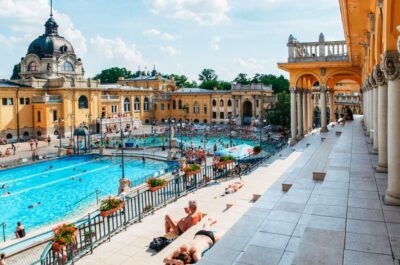
Széchenyi Spa Day Ticket with Optional Upgrades
Read our review →


Budapest Danube Cruise and Dinner Options, Live Music and Dance
Read our review →