
REVIEW · HISTORICAL TOURS
Classic Walk in Budapest Historical Center
Budapest reveals itself one square at a time. This two-hour walk gives you a useful first look at Pest, linking Váci Street, the Danube, St. Stephen’s Basilica, Parliament, and key sites tied to Hungary’s difficult 20th-century past. I like the low price and the way the route ends at Parliament, where you can continue exploring on your own.
I also like the chance to ask a local guide for food and drink suggestions, something Oliver did particularly well for one group. The main concern is pacing: one guest felt there was too much explanation and not enough walking, so this may feel slow if you prefer a brisk sightseeing march.
In This Review
- Key points to know before booking
- What this Budapest walk is really designed to do
- Starting on Váci Street
- The Danube view and Buda Castle across the river
- Pesti Vigadó and the end of the pedestrian street
- Elizabeth Square, the fountain, and the Ferris wheel
- St. Stephen’s Basilica and its unfinished story
- Szabadság tér and the difficult 20th century
- Kossuth Lajos Square and the 1956 revolution
- Finishing at the Hungarian Parliament Building
- Pacing, group size, and guide style
- Who gets the best value from this walk
- Booking, timing, and cancellation details
- Should you book Classic Walk in Budapest Historical Center?
- FAQ
- How long does the Classic Walk in Budapest Historical Center last?
- Where does the tour start?
- Where does the tour end?
- Is entry to St. Stephen’s Basilica included?
- Is entry to Parliament or museums included?
- What language is the tour offered in?
Key points to know before booking
- The tour crosses central Pest in about two hours, from Váci Street to Kossuth Lajos Square.
- The Danube and Buda Castle views are a major highlight, especially from the Pest riverfront.
- Hungarian history gets serious, with stops covering Nazi occupation, Soviet rule, and the 1956 revolution.
- The price is unusually low at $3.60 per person, making this a strong orientation walk if the schedule suits you.
- Oliver earned praise for tailoring the walk, asking about interests and offering practical food and drink advice.
- The group can reach 30 people, though some departures may be much smaller.
What this Budapest walk is really designed to do
This is an introduction, not a deep architectural tour or an inside visit to Budapest’s major buildings. You spend roughly two hours moving through central Pest, hearing short explanations, seeing important monuments, and getting a basic map of the city in your head.
That purpose matters. Budapest can feel spread out at first, with Buda on one side of the river and Pest on the other. This route helps you understand the Pest side while repeatedly connecting the city’s streets, squares, river views, and political landmarks.
The walk also gives you a quick outline of Hungarian history. You hear about major events and see the places where those events are remembered. That combination is useful because Budapest’s monuments are not only pretty facades. Many point to occupation, dictatorship, resistance, national identity, and the struggle for freedom.
At $3.60, the value is easy to see. You are paying very little for live guiding, a central route, and the chance to ask questions. The tradeoff is that you should not expect entry to the basilica, museums, or Parliament. You are mainly paying for interpretation and orientation outdoors.
More history tours in Budapest:
- Budapest: Historic Cruise with Welcome Drink
★ 4.7 · 6,512 reviews - Budapest Historical Sightseeing – Free Walking Tour
★ 5.0 · 1,302 reviews - Buda Castle District Dark History, Legends and Vampire Night Tour
★ 4.5 · 1,240 reviews
Starting on Váci Street
The meeting point is Molnár’s kürtőskalács at Váci u 31. Váci Street is Budapest’s famous pedestrian shopping street, and it makes a practical starting place because you begin among central shops, cafés, and foot traffic.
The first stop is brief, listed at about five minutes. That is enough to get a feel for the street, but not enough for a long look at every building or shop. I would treat this section as a gentle start rather than a major sightseeing stop.
The street is also a reminder that central Budapest mixes daily shopping with sightseeing. You are not beginning at an isolated monument. You are stepping into one of Pest’s best-known public spaces, then moving toward the river.
If you plan to arrive early, allow time to locate the meeting point near the kürtőskalács shop. Confirmation is provided when you book, and the experience is near public transportation, which makes reaching the center fairly simple.
The Danube view and Buda Castle across the river
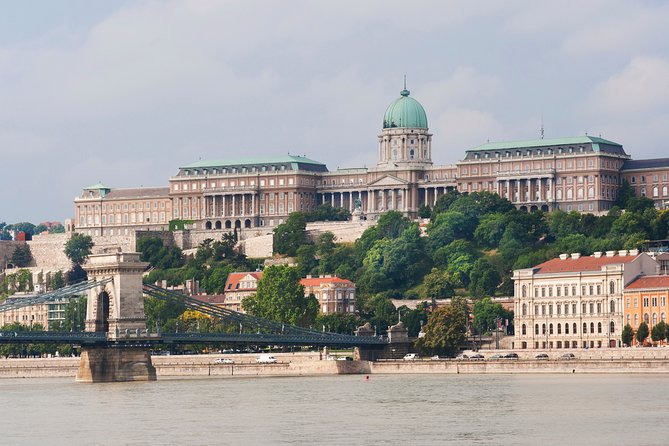
The route then reaches the Danube, called the Blue Danube in the tour description. This is one of the walk’s strongest visual moments. From the Pest side, you can look across the water toward Buda Castle and see Budapest’s historic bridges linking the two halves of the city.
I like this part because it gives you the city’s basic shape immediately. Instead of hearing that Buda and Pest are different areas, you can see the separation yourself. The river is not just scenery here. It explains how the city developed and why the bridges matter so much.
The view also provides a welcome change from streets and buildings. If the day is hot, the open riverfront may still feel exposed, but the guide on one small-group departure made a point of keeping people in the shade and walking at a comfortable pace. That sort of care can make a real difference during warm weather.
Do not expect a long river cruise or a full bridge-by-bridge tour. This is a walking stop with a view and historical context. You will want your camera ready, but the main value comes from understanding where you are.
Pesti Vigadó and the end of the pedestrian street
Pesti Vigadó is a handsome dance palace built in the 1860s in the Hungarian Romantic style. The tour allows about ten minutes here, giving the guide time to explain the building and its place in Budapest’s cultural life.
Admission is not included, so you should plan on seeing it from the outside unless you choose to pay separately. The route does not turn this into an interior visit, and that is worth knowing if you are hoping to explore concert halls or exhibits.
From here, you reach the end of the pedestrian street and a square lined with pastry shops and café terraces. This is one of the most useful practical moments on the walk. You are shown an area where you can pause later for coffee, cake, or a meal.
A guide who pays attention to food questions can add real value here. Oliver was praised for asking about individual interests and giving advice on what to eat and drink. I would use this part of the walk to ask for specific local recommendations, since the route passes through several places you might return to after the tour.
More walking tours in Budapest:
- Budapest: Buda Castle Walk with Saint Stephen’s Hall
★ 4.5 · 3,012 reviews - Big Bus Budapest Hop-On Hop-Off Bus and Walking Tour
★ 3.5 · 2,206 reviews - Budapest: Buda Castle District Walking Tour
★ 4.6 · 2,108 reviews - Budapest City Landmarks Walking Tour in 2 Hours
★ 5.0 · 2,048 reviews
Elizabeth Square, the fountain, and the Ferris wheel
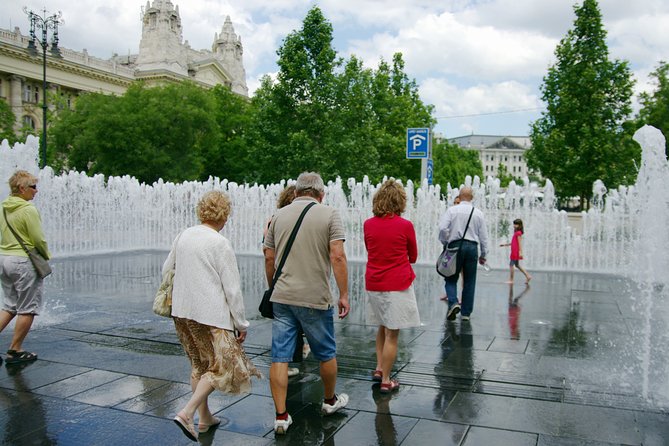
Elizabeth Square gives the walk a bit more breathing room. You cross the park and see the Danube Fountain monument and Budapest’s giant Ferris wheel. The stop lasts about 15 minutes, and admission to the square is free.
This is a good contrast with the formal buildings earlier in the walk. You see a public park used for relaxation, movement, and city life, while the Ferris wheel adds a modern attraction to the historic center.
The stop is not meant to be a ride on the wheel. It is a chance to understand the square and see two recognizable features in one place. If you are building your own sightseeing plan, the guide’s explanation can help you decide if you want to return later.
The route’s variety works well here. In a short time, you have seen a shopping street, the river, a 19th-century cultural building, cafés, and a public park. That range is why this tour works best early in a Budapest visit.
St. Stephen’s Basilica and its unfinished story
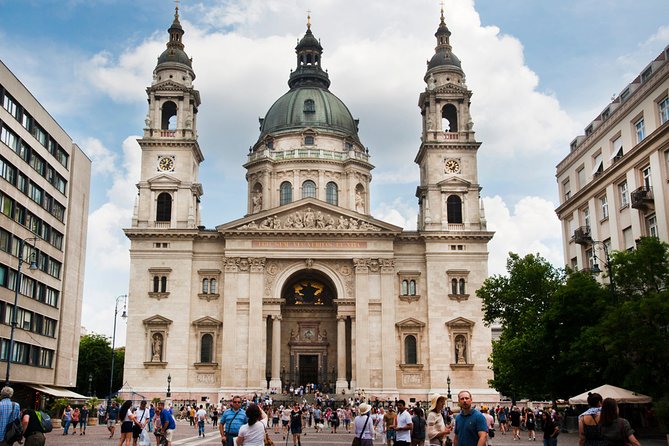
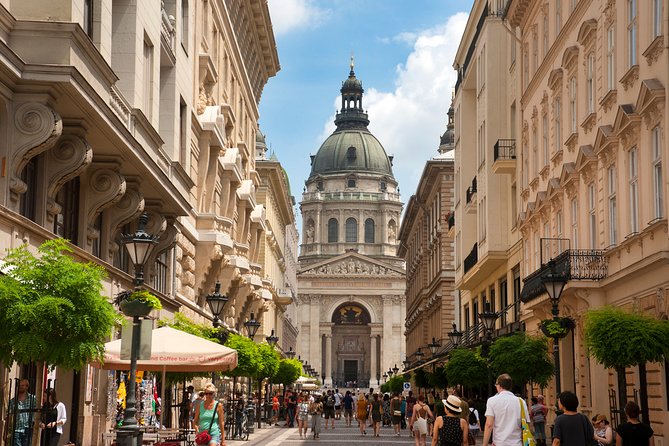
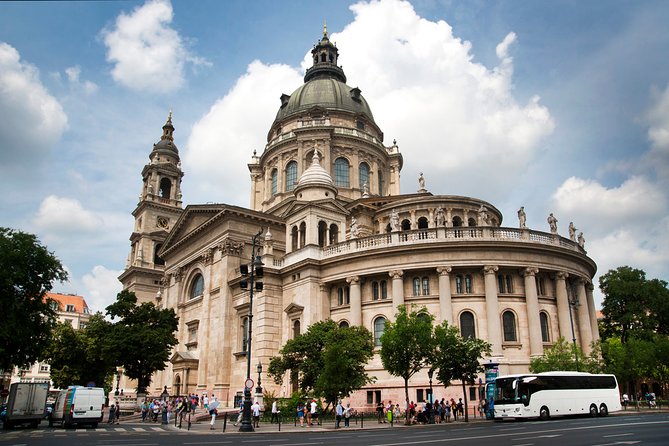
St. Stephen’s Basilica receives about 20 minutes, making it one of the longer stops. You admire the enormous church and hear about its construction and symbolism.
The basilica is an important landmark, but entry is not included. The guide can explain what you are seeing from outside, while any interior visit requires a separate ticket. The same applies to access beyond the public areas of the building.
The construction story gives the stop more substance than a quick photo opportunity. Religious buildings often tell you how a city saw itself, and the basilica’s scale makes that clear. Here, the guide connects the building to Hungarian identity and religious symbolism.
I would not count on this tour satisfying a strong interest in church interiors. Instead, think of it as a useful introduction before you decide if you want to return. If the basilica is high on your personal list, leave extra time after the walk for your own visit.
Szabadság tér and the difficult 20th century
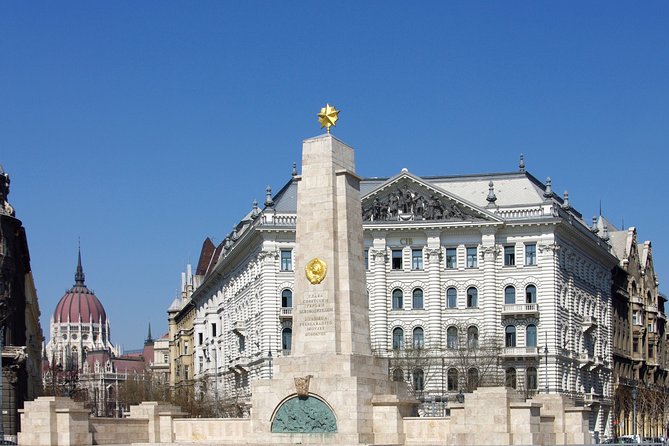
Szabadság tér, or Liberty Square, is where the walk turns toward Hungary’s more painful modern history. The stop lasts about 25 minutes, the longest scheduled stop on the route.
You see monuments connected with Nazi and Soviet occupation, along with reminders of the dictatorships that shaped Hungary. During the warm season, you can also see the square’s miraculous fountain. The contrast between an open urban square and these heavy political memories can be striking.
This is the point where the guide’s storytelling matters most. A monument alone can be confusing, especially when several periods of occupation and political control appear in one place. A clear timeline helps you understand why the memorials were built and how Hungarians remember those years.
The long stop may be exactly right for you if you want context rather than a quick photo. It may feel too slow if you mainly want to cover ground. One negative experience with the tour came from spending too long at stops that did not feel interesting enough to that particular guest. That is a fair warning: the walk gives priority to explanation, not just movement.
Kossuth Lajos Square and the 1956 revolution
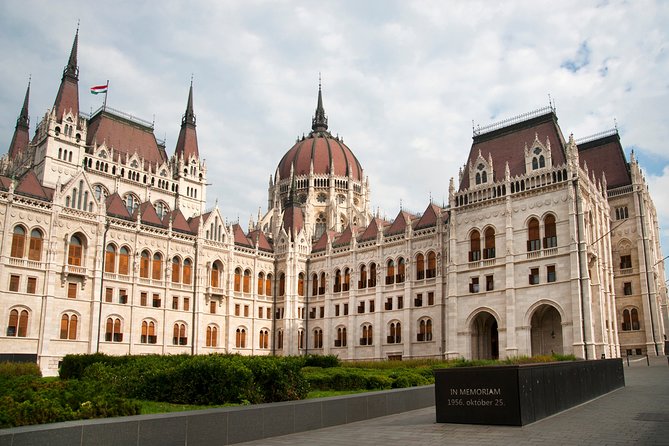
The route continues to Kossuth Lajos Square, one of Budapest’s most important civic spaces. You see memorials to Hungarian freedom heroes and hear about the 1956 revolution against Communist rule.
This stop helps connect the earlier occupation monuments with the idea of national resistance. You are not simply looking at grand government buildings. You are hearing how ordinary people and political movements challenged outside control and dictatorship.
The square is also the setting for the tour’s final landmark, the Hungarian Parliament Building. That placement makes sense. Parliament is both a visual climax and a powerful symbol of Hungarian government and independence.
The stop lasts about 15 minutes. Again, the goal is an overview. You will get a framework for the events, but anyone wanting a detailed study of 1956 should plan a separate museum visit or longer historical tour.
Finishing at the Hungarian Parliament Building
The walk ends at the Hungarian Parliament Building at Kossuth Lajos tér 1 to 3. You admire the building and hear about its history, but entry is not included.
This is an excellent ending because Parliament is one of Budapest’s most memorable sights. Reaching it on foot, after passing through the city’s streets and political memorials, gives the building extra meaning. You have seen the public spaces around power before arriving at the most famous symbol of the Hungarian state.
Do not confuse seeing Parliament with touring Parliament. If you want to go inside, you need to arrange that separately. The walk is still valuable because it places the building within the city rather than presenting it as an isolated photo stop.
The ending also gives you flexibility. From Kossuth Lajos Square, you can continue exploring on your own, revisit the riverfront, or use public transportation to reach another part of Budapest.
Pacing, group size, and guide style
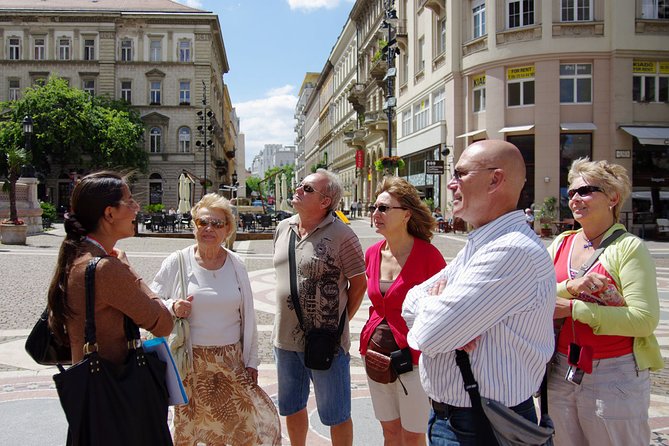
The advertised maximum is 30 people, which is large enough to affect how personal the experience feels. A group of that size can require careful listening and may make questions harder during busy street crossings or crowded public areas.
At least one departure was very small, and that created a more personal experience. The guide could check that everyone was comfortable, keep the group in the shade, and adjust the walking speed. You should not assume every departure will be that intimate, but the possibility is worth noting.
The guide style appears to lean toward explanation and conversation. Oliver was praised for asking what interested people and shaping the walk around those interests, while also covering more Hungarian history than expected. Practical food and drink suggestions were another strong point.
That approach suits you if you want a local introduction and enjoy asking questions. It is less ideal if you want a fast route with only short photo stops. The 4.4 rating suggests a generally positive experience, but the mixed response about pacing should be taken seriously.
Who gets the best value from this walk
I would choose this tour if you are visiting Budapest for the first time and want a quick mental map of central Pest. It is especially useful when you want the main sights explained before returning to the places that interest you most.
It also suits you if Hungarian history feels unfamiliar. The walk gives you a basic sequence of major events and places those events beside visible monuments. That context can improve later visits to museums, churches, Parliament, and the riverfront.
The tour is a good match for:
- First-time visitors who want a central orientation
- People who enjoy history and political context
- Visitors who want local advice about food and drinks
- Anyone seeking a very inexpensive guided activity
- Small groups fortunate enough to receive a more personal departure
I would hesitate if you dislike long explanations, have limited walking time, or mainly want interior access. No church or museum entry is included, and Parliament is viewed from outside.
The route is described as suitable for most people, with service animals allowed and public transportation nearby. Since it lasts about two hours and includes several central stops, you should still be prepared to walk at an ordinary city sightseeing pace.
Booking, timing, and cancellation details
The experience is offered in English, includes a mobile ticket, and may offer group discounts. It is often booked well ahead, with an average booking time of 67 days in advance. That does not guarantee you must reserve that early, but it suggests popular dates can fill sooner than the low price might imply.
Free cancellation is available if you cancel at least 24 hours before the starting time. Cancellations or changes made within 24 hours are not accepted for a refund, and the cut-off follows local Budapest time.
Should you book Classic Walk in Budapest Historical Center?
I would book it for a first day in Budapest, particularly at $3.60 per person. You get the city’s main Pest landmarks, a Danube viewpoint, a useful outline of Hungarian history, and a place to finish your independent sightseeing.
Go in expecting an outdoor overview, not a series of interior visits. If you prefer careful explanations, ask questions, or want advice about where to eat and drink, this walk offers strong value. If you want a fast-moving tour with little commentary, the longer stops at Szabadság tér and other landmarks may test your patience.
FAQ
How long does the Classic Walk in Budapest Historical Center last?
The walking tour lasts approximately two hours.
Where does the tour start?
It starts at Molnár’s kürtőskalács, Budapest, Váci u 31, 1052 Hungary.
Where does the tour end?
The tour ends at the Hungarian Parliament Building, Budapest, Kossuth Lajos tér 1 to 3, 1055 Hungary.
Is entry to St. Stephen’s Basilica included?
No. Entry to the church is not included in the tour price.
Is entry to Parliament or museums included?
No. The tour includes live guiding, but museum entry and access to the Hungarian Parliament Building are not included.
What language is the tour offered in?
The tour is offered in English.
Just added in Budapest
- Budapest: Private Walking Tour with a Local Guide★ 3.6 · 6 reviews
- Budapest: Danube River Views Bike Ride★ 4.8 · 23 reviews
- Budapest: City Bike Tour with Coffee Stop★ 5.0 · 37 reviews
- Walking consultancy with alternative psychologist and author★ 5.0 · 2 reviews
- From Budapest: Guided Tour of Eger with Wine Tasting★ 4.5 · 6 reviews
- Walk to recent and aged spiritual sanctuaries near Budapest★ 5.0 · 5 reviews
- Budapest: Guided Tour of the Parliament Building in Spanish★ 4.6 · 1,240 reviews
- Budapest: 3-Hour Trabant Sightseeing Tour★ 4.7 · 28 reviews
Historical Tours, compared.
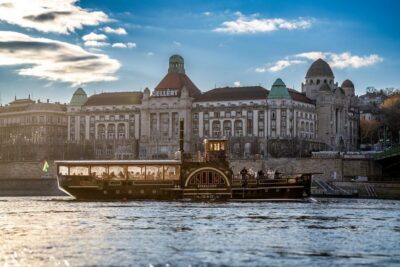

Budapest Historical Sightseeing – Free Walking Tour
Read our review →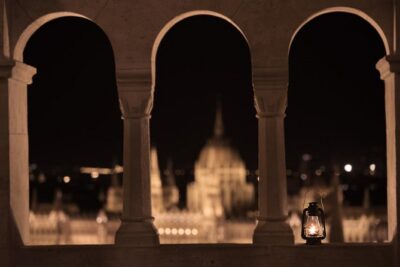
Buda Castle District Dark History, Legends and Vampire Night Tour
Read our review →
BloodThirsty Hungary: Walking tour & Dark Historical Stories
Read our review →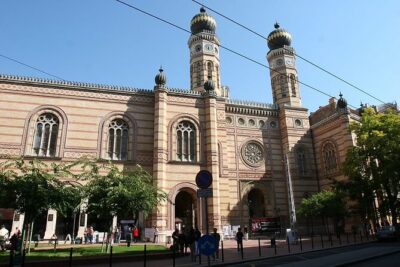
Budapest Jewish Heritage Memorial Walking Tour & Synagogue Entry
Read our review →
Jewish Heritage Guided Tour with Synagogue Ticket
Read our review →
Budapest Historic Downtown Bicycle Tour in small groups
Read our review →
Historic Downtown ride on E-Bicycles Buda & Pest
Read our review →Browse the lists this tour appears in