REVIEW · TOURS
Tiny Sculptures, Big Stories: Kolodko mini statue tour
Look closely, Budapest has secrets at your feet. This Kolodko statue tour turns the city into a treasure hunt, leading you to Mihail Kolodko’s small bronze sculptures and the stories attached to them. I like the playful search for statues that are easy to miss, and I like how the route links local folklore with Budapest’s neighborhoods, history, and street art.
The guide, ET, also called Etele, receives the strongest praise here. He brings energy, humor, and a personal feel, often adjusting the route around your interests or the parts of Budapest you have already seen. The main consideration is simple: this is not a short, fixed walking loop. You will walk, use public transport, and spend about two and a half hours moving between parts of the city.
- A citywide treasure hunt: Search for tiny bronze figures tucked into streets, squares, and corners around Budapest.
- Stories before snapshots: Each sculpture connects to local folklore, pop culture, politics, neighborhood life, or a piece of Hungarian history.
- Public transport included: Tram, metro, train, and other city connections may form part of the route, with ticket costs covered.
- A flexible route: ET may shape the outing around your interests, previous sightseeing, and the statues available along the way.
- Pest to Buda: Meet near the New York Café and finish at Szent Gellért tér, close to the Danube and useful transport links.
In This Review
- Why Tiny Statues Make a Good Budapest Tour
- Starting at the New York Café on the Pest Side
- The Statue Hunt: Look First, Then Listen
- Local Folklore, Politics, and Everyday Budapest
- Crossing Budapest by Foot and Public Transport
- The Synagogue, the Danube, and the Unlisted Stops
- ET’s Guiding Style and the Small-Group Advantage
- What the $35 Price Really Buys
- Who Will Enjoy This Most
- Booking Details Worth Knowing Before You Go
- Should You Book the Kolodko Statue Tour?
- FAQ
- Where does the Kolodko mini statue tour start?
- Where does the tour finish?
- How long does the tour last?
- Are public transport tickets included?
- What language is the tour offered in?
- How many people can join the tour?
Why Tiny Statues Make a Good Budapest Tour
Budapest has no shortage of grand sights. The Danube, the synagogue, the bridges, and the hilltop views rightly fill most first-time schedules. But a city can also reveal itself through small jokes, local characters, odd memories, and pieces of art you would walk past without help.
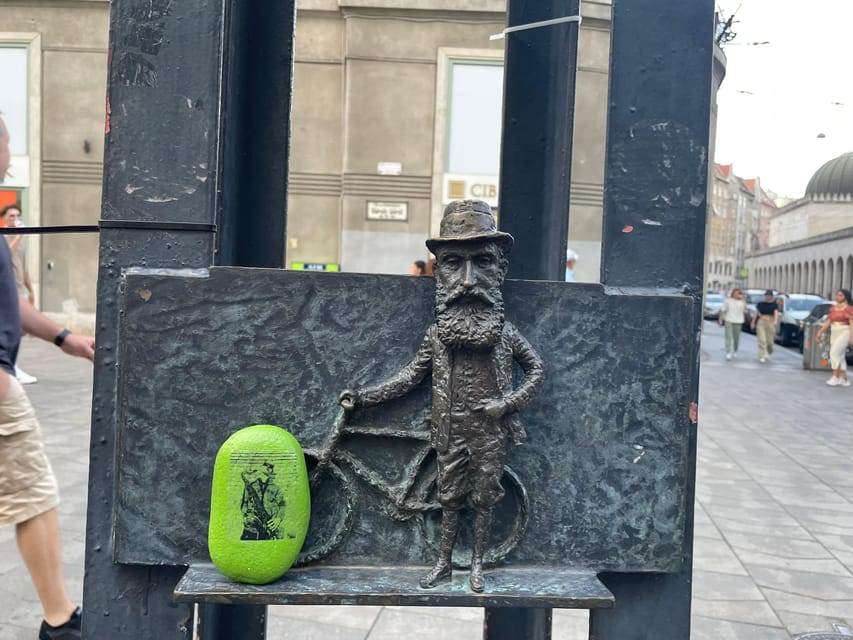
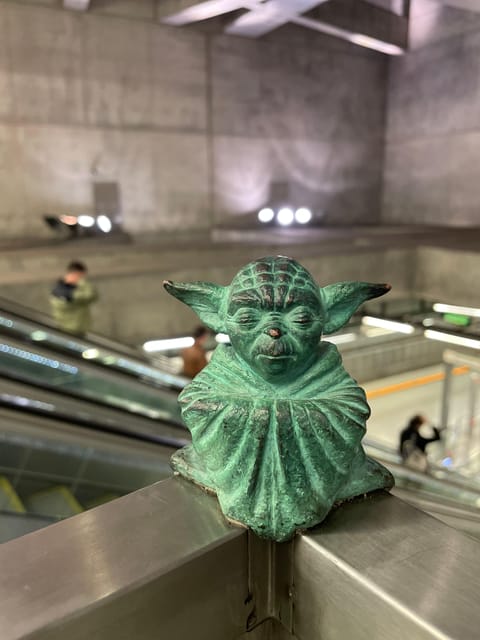
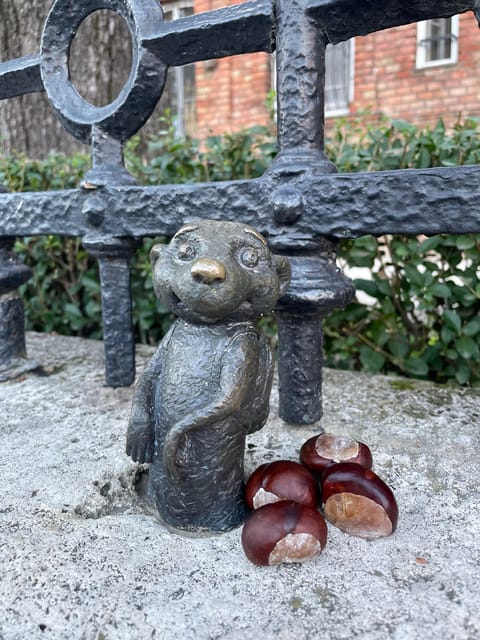
That is the appeal of Mihail Kolodko’s work. His miniatures are not presented as a formal museum collection. They appear around the city, often in places where you need to look carefully. Finding one gives you the small thrill of discovery, then the guide explains why that figure is there and what it means.
I like this format because the art becomes a doorway into Budapest rather than the whole subject. One statue can lead to a discussion of a neighborhood. Another can point toward a local legend, a political reference, or a bit of popular culture. You are not simply collecting photographs. You are learning how Budapest remembers, jokes, and comments on itself.
The tour is especially useful if you have already seen the major monuments. It shifts your attention from the grand view to the detail beside the pavement. If this is your first activity in the city, it can also help you get your bearings, since the route crosses different parts of Budapest instead of staying in one sightseeing zone.
Starting at the New York Café on the Pest Side
The meeting point is in front of the entrance to the New York Café. This is a clear and well-known place, but allow a little extra time to find your guide in the area. The café itself is one of Budapest’s famous grand interiors, so you begin in a very polished setting before heading out to search for much smaller works of art.
The contrast is part of the fun. The New York Café represents Budapest’s elaborate, old-world side. Kolodko’s statues are modest, witty, and often easy to overlook. Moving from one to the other sets up the central idea of the tour: you will see the city’s public face, but you will also pay attention to its odd corners and private jokes.
ET’s style appears to suit this beginning well. He is described as friendly, funny, energetic, and easy to listen to. That matters on a tour built around stories. A guide who can explain a statue in a short, lively way keeps the search moving instead of turning every stop into a lecture.
More things to do in Budapest:
- Budapest: City Highlights Cruise with Welcome Drink
★ 4.6 · 35,610 reviews - Budapest: Unlimited Prosecco, Beer and Aperol Spritz Cruise
★ 4.8 · 25,310 reviews - Budapest: Széchenyi Spa Day Ticket with Optional Upgrades
★ 4.3 · 23,911 reviews
The Statue Hunt: Look First, Then Listen
The most enjoyable part is the act of finding the sculptures. ET may point you toward an area and let you scan the surroundings before revealing the exact spot. This small change makes a difference. You feel as if you have discovered the statue, not simply been led to it.
The figures are small enough that you might miss them on your own. That is one of the tour’s real benefits. Independent exploration can take you past the city’s major art installations, but a guide who knows where to look can bring out a second layer of Budapest.
Expect the number of statues to vary. Several outings reached about 15 sculptures, while one flexible route found more. One participant later located 25 statues around the city using information from the tour. Your total will depend on the group, the route, the pace, the weather, and how much time you spend talking at each stop.
That variation is worth understanding before you book. This is not a promise of a fixed statue count. It is a guided search through the city, with the route adjusted as needed. If you want to see as many as possible, wear comfortable shoes and be ready to keep moving.
Local Folklore, Politics, and Everyday Budapest
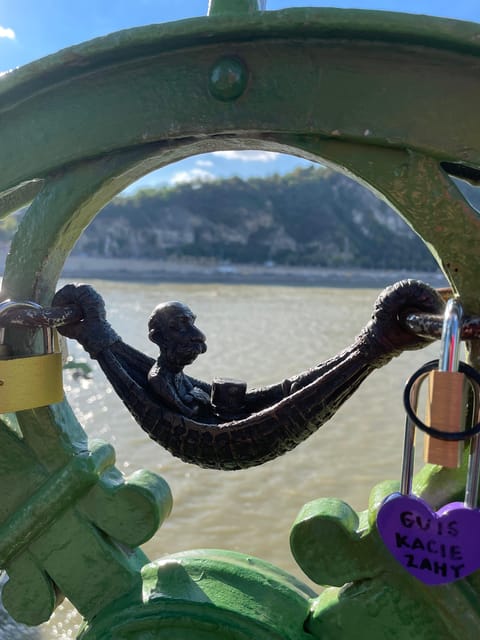
Kolodko’s statues work because they are small but rarely meaningless. They may honor a local figure, refer to a familiar story, nod toward a political subject, or reflect something about the neighborhood where they appear.
ET adds the context that makes each piece useful. His explanations cover the statue itself, but also Budapest’s street art scene, local culture, politics, everyday life, and changes in the city. That wider conversation is one of the most praised parts of the experience.
I would not book this only for an art lesson. The tour is better understood as a blend of street art, city orientation, and storytelling. You might spend a few minutes discussing a miniature sculpture, then shift to the street around it, the people who use that area, or the past events that give the artwork its meaning.
This is also a good choice if you enjoy asking questions. Smaller groups make conversation easier, and the maximum group size is 10 people. When attendance is low, the experience may feel close to a private walk. ET has customized routes for people who had already visited certain sights or wanted to focus on particular subjects.
Crossing Budapest by Foot and Public Transport
The tour begins on the Pest side and finishes on the Buda side at Szent Gellért tér. That point near the Danube gives the experience a satisfying geographic shape, but it also means you should expect more than a gentle stroll around one neighborhood.
Public transport tickets are included. The exact combination can vary, but the experience uses Budapest’s network to connect different locations. Specific outings have involved trams, the metro, trains, and, in some cases, bikes. The important point is that transport is part of the sightseeing, not an inconvenience added between attractions.
This format lets you see more statues than a compact walking route could cover. It also gives you a better sense of how Budapest fits together. You pass from one district to another instead of viewing the city as a string of isolated monuments.
The trade-off is pace. You may need to board a tram, cross busy roads, change direction, or walk farther than expected. I would wear sturdy, comfortable shoes and dress for the forecast. A cold and snowy outing still worked well for one participant, but poor weather will make a mobile tour less pleasant than a museum visit.
A completely different kind of day:
- Budapest: Nighttime or Daytime Sightseeing Cruise
★ 4.2 · 21,062 reviews - Budapest: 1-Hour Evening Sightseeing Cruise with Drink
★ 4.5 · 8,330 reviews - Budapest Danube Cruise and Dinner Options, Live Music and Dance
★ 4.5 · 7,428 reviews - Budapest: Historic Cruise with Welcome Drink
★ 4.7 · 6,512 reviews
The Synagogue, the Danube, and the Unlisted Stops
The headline sights include a synagogue and the Danube, but the experience is not structured as a standard monument tour. These places form part of a wider route that mixes familiar Budapest landmarks with less obvious corners.
That balance gives the tour its value. You may see a major sight from a different angle, then turn your attention to a miniature statue nearby. The large attraction supplies context and scale. The tiny bronze figure supplies the surprise.
The itinerary also refers to a secret stop. Since the route can change, you should treat this as a promise of discovery rather than a named attraction with a guaranteed format. The available information does not identify the stop, and that uncertainty is part of the experience’s flexible character.
Finishing at Szent Gellért tér is practical. From there, you are at a central Buda location with public transport options for returning elsewhere in the city. It is also a useful place to continue exploring the Danube area after the tour ends.
ET’s Guiding Style and the Small-Group Advantage
The guide can make or break a story-based tour, and ET receives consistent praise for his warmth, humor, and ability to connect different subjects. He is described as someone who talks about the city with genuine affection, not as someone rushing through a memorized list.
His strongest quality seems to be flexibility. If you have already visited certain parts of Budapest, he can alter the route. If you are curious about pop culture, local politics, street art, or daily life, you can ask questions along the way. If the group is small, there is more room for that conversation.
The official limit is 10 participants. That is small enough for a personal feel while keeping the price below a private tour. Still, do not assume every departure will be private. Some outings had one or two people, while another group included five friends.
This matters for expectations. A very small group may allow more customization and a slower conversation. A fuller group may have a livelier shared atmosphere but less control over the route. ET’s reported approach suggests he works to accommodate people in either setting.
What the $35 Price Really Buys
At $35 per person, this sits in a reasonable range for a two-and-a-half-hour guided city experience, especially since public transport tickets are included. You are paying for more than a list of statue locations. The useful part is the guide’s knowledge of where the sculptures are, why they were placed there, and how to connect them to Budapest.
You could search for Kolodko statues independently, but you would need a map, time, and patience. The small figures are spread around the city, and finding them without help can be hit or miss. The tour gives you a working route and the stories at the same time.
The value rises if you like personal interaction. ET has shared a map afterward in at least one case, allowing people to continue looking for sculptures independently. That turns the tour into a starting point for your own city walk rather than a one-time activity.
The price is less attractive if you want a conventional sightseeing tour with long stops at Budapest’s major monuments. The route may pass attractions without offering a full interior visit or detailed architectural tour. For that, book a dedicated city-history or museum experience instead.
Who Will Enjoy This Most
I would recommend this tour to you if you enjoy:
- Street art, public art, and unusual city details
- Local legends and stories tied to real places
- Walking tours with conversation rather than a strict script
- Finding things that are easy to miss
- Using public transport as part of seeing a city
- Smaller groups and the chance to ask questions
- A less formal introduction to Budapest
Families may also enjoy the treasure-hunt quality, and one participant specifically recommended it for adults and children. The amount of walking and the use of public transport still mean that each person in your group should be comfortable staying on the move for most of the outing.
You may want another kind of tour if you have limited mobility, dislike changing transport, or prefer to remain indoors. No accessibility details are provided, so ask the operator before booking if you need specific arrangements.
This is also not the best pick if you care only about famous landmarks. The synagogue and Danube are part of the route, but the focus remains on Kolodko’s small sculptures and the neighborhoods around them.
Booking Details Worth Knowing Before You Go
The advertised duration is 2.5 hours, while the itinerary description refers to a three-hour guided tour. Since the route and transport connections can vary, confirm the current timing when you check available starting times.
The tour is offered in English with a live guide. Public transport tickets are included, but personal expenses beyond that are not specified as included. The meeting point is in front of the New York Café entrance, and the tour finishes at Szent Gellért tér.
You can cancel up to 24 hours before the activity for a full refund. A reserve-now, pay-later option is also available, which helps if your Budapest plans are still shifting.
Bring comfortable shoes. That is the clearest practical advice from the experience itself. You should also keep your eyes open between stops, since the best part may be spotting a miniature figure before ET points it out.
Should You Book the Kolodko Statue Tour?
Book it if you want Budapest to feel personal, playful, and a little unexpected. The combination of tiny bronze sculptures, local stories, public transport, and ET’s adaptable guiding makes this more than a photo hunt.
I especially like it as an early Budapest activity because it helps you understand the city’s layout and gives you details to notice during the rest of your stay. It also works well near the end of a visit, when the major sights are already familiar and you want a different way to look at the city.
Skip it if you want a fixed route, a long stop at every major monument, or a quiet indoor experience. For everyone else, $35 is a fair price for a lively small-group outing that can show you parts of Budapest you would probably miss on your own.
FAQ
Where does the Kolodko mini statue tour start?
The tour starts in front of the entrance to the New York Café in Budapest.
Where does the tour finish?
The tour finishes at Szent Gellért tér on the Buda side of the city.
How long does the tour last?
The advertised duration is 2.5 hours. The itinerary description also refers to a three-hour guided tour, so confirm the current timing when booking.
Are public transport tickets included?
Yes. Public transport tickets are included in the activity price.
What language is the tour offered in?
The tour is offered in English with a live English-speaking guide.
How many people can join the tour?
The group is limited to 10 participants. Some departures may have fewer people, and very small groups can allow more route customization.
Just added in Budapest
- Budapest: Private Walking Tour with a Local Guide★ 3.6 · 6 reviews
- Budapest: City Bike Tour with Coffee Stop★ 5.0 · 37 reviews
- Budapest: Danube River Views Bike Ride★ 4.8 · 23 reviews
- From Budapest: Guided Tour of Eger with Wine Tasting★ 4.5 · 6 reviews
- Walk to recent and aged spiritual sanctuaries near Budapest★ 5.0 · 5 reviews
- Walking consultancy with alternative psychologist and author★ 5.0 · 2 reviews
- Budapest: Guided Tour of the Parliament Building in Spanish★ 4.6 · 1,240 reviews
- Budapest: 3-Hour Trabant Sightseeing Tour★ 4.7 · 28 reviews
Tours, compared.
City Sightseeing Hop-On Hop-Off Bus Tour & Extras
Read our review →
Buda Castle District Vampires and Myths Night Tour
Read our review →
Budapest City Landmarks Walking Tour in 2 Hours
Read our review →
3-Hour Orientation Walking Tour of Buda and Pest
Read our review →