
REVIEW · WALKING TOURS
Budapest Grand Walk
Budapest rewards a good first walk. This four-hour tour gives you a lively introduction to Pest, linking grand avenues, revolution-era sites, the Jewish Quarter, and the Danube in one long outing. I especially like the opening glass of Hungarian sparkling wine and the short ride on continental Europe’s oldest metro line. The main tradeoff is simple: you cover a lot of ground, so comfortable shoes and steady energy matter.
The small-group format, capped at eight people, should make it easier to ask questions and hear the guide. Guides such as Aniko and Angela have earned especially warm praise for clear storytelling and flexible pacing. Just remember that this is an overview, not a deep visit inside every major building, and the $125 price is easiest to justify if you want history, orientation, and local conversation in one package.
In This Review
- Key points at a glance
- Why this Budapest walk works well on a first day
- Starting with wine in the Palace district
- Andrássy Avenue, the Opera House, and St. Stephen’s Basilica
- Heroes Square and a ride on Budapest’s oldest metro
- Entering the former Jewish Quarter
- Liberty Square and the politics of public memory
- The Danube promenade and the Shoes on the Danube
- Pace, group size, and what the $125 covers
- Who should book the Budapest Grand Walk
- Should you book it?
- FAQ
- How long does the Budapest Grand Walk last?
- Where does the tour begin?
- Where does the tour end?
- Is food or drink included?
- How many people can join the shared tour?
- Is the tour suitable for people who do not drink coffee?
Key points at a glance

- A four-hour route through Pest: See the National Museum, Opera House, St. Stephen’s Basilica, Heroes Square, the Jewish Quarter, and the Danube promenade.
- A personal start at Tasting Table Budapest: Meet in a wine cellar on Bródy Sándor Street and begin with Hungarian sparkling wine.
- History tied to real streets: Hear about the 1956 Revolution, Hungary’s rulers and dictators, Jewish Budapest, Soviet influence, and daily life today.
- A useful public-transport stop: Ride Budapest’s historic yellow metro line instead of walking every section of this wide-ranging route.
- A strong finish by the river: See the Shoes on the Danube Memorial, Parliament, Chain Bridge, and Buda Castle from the Pest bank.
- Small-group and private choices: The shared tour takes 2 to 8 people, with larger-group and private options available.
Why this Budapest walk works well on a first day
Budapest can feel like two cities at once. Buda rises across the river, while Pest spreads across broad boulevards and dense central streets. This tour concentrates on Pest but gives you fine views toward Buda, helping you place the city before you set off on your own.
I like the way the route mixes famous sights with less polished corners. You do not simply move from one postcard view to the next. In the Palace district, you pass handsome buildings that have seen better years, the Hungarian National Radio Building, and the National Museum. These places help explain how Budapest’s past lives in ordinary streets, not only in its grandest monuments.
The tour also links periods that are often taught separately. You may hear about medieval kings, the Ottoman period, the Austro-Hungarian era, the 1956 Revolution, the Holocaust, Soviet rule, and modern Hungarian life in the same afternoon. A good local guide can make that long story manageable, and the strongest part of this experience is its focus on dates, people, and political change.
The broad route has a cost. You will not spend long inside most buildings, and the tour does not include admission to the interiors of the basilica, synagogue, Parliament, or Buda Castle. Think of it as a city orientation with selected stops, not a series of full museum visits.
More walking tours in Budapest:
- Budapest: Buda Castle Walk with Saint Stephen’s Hall
★ 4.5 · 3,012 reviews - Big Bus Budapest Hop-On Hop-Off Bus and Walking Tour
★ 3.5 · 2,206 reviews - Budapest: Buda Castle District Walking Tour
★ 4.6 · 2,108 reviews
Starting with wine in the Palace district
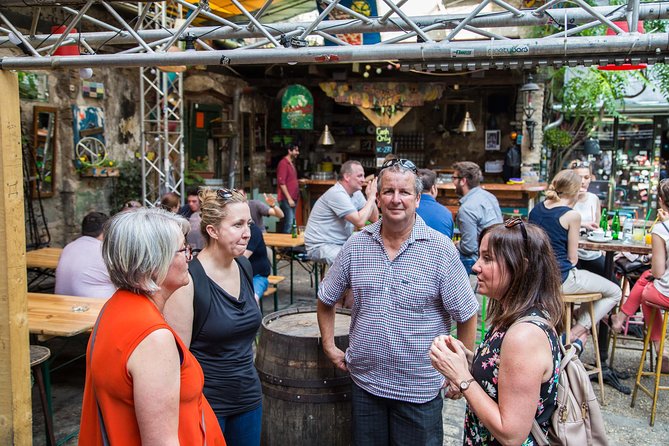
Your meeting point is Tasting Table Budapest, a wine shop and cellar at Bródy Sándor u. 22. The tour begins with about 15 minutes for an aperitif, including a glass of Hungarian sparkling wine.
That opening is more than a pleasant extra. It gives you a quiet moment to meet the guide and fellow walkers before the pace picks up. If you have just arrived after a long flight, this pause can help you shift into Budapest time without losing half the afternoon to a hotel nap.
The Palace district is a smart place to begin. The name refers to the grand buildings and civic institutions in this part of Pest, but the streets also show wear, repairs, and the uneven texture of a living capital. You get an early look at Budapest beyond its polished center.
The Hungarian National Radio Building adds a serious historical note. It played an important part during the 1956 Revolution, when Hungarians challenged Soviet control. Hearing about that event while standing near one of its key sites gives the history a physical setting.
The National Museum follows naturally. Even if you do not enter, its role in Hungarian public life helps explain why this part of the city mattered during periods of political change. Your guide can also point out architectural details and explain how the surrounding streets fit into the city’s development.
Andrássy Avenue, the Opera House, and St. Stephen’s Basilica
From the Palace district, the walk reaches some of Pest’s most impressive public spaces. Andrássy Avenue is one of the city’s grandest routes, lined with elegant buildings and connected to major sights farther east.
The Hungarian State Opera House is a highlight along the way. Its neo-Renaissance design came from architect Miklós Ybl, and the building gives the avenue a sense of ceremony. You pass it rather than take a full interior tour, so this stop works best for architecture, photographs, and a short explanation of the Opera House’s place in Budapest culture.
St. Stephen’s Basilica provides another visual change. This Catholic church is named for Stephen, Hungary’s first king, and its treasury includes his mummified right hand. The tour allows about 15 minutes at the basilica, enough to see the exterior and understand its significance, though not enough for an unhurried visit if you want to explore every detail.
I appreciate that the tour places national history beside religious history. Stephen represents the country’s early Christian kingship, while the nearby streets carry the marks of later political and social change. The guide’s job is to connect those pieces without turning the walk into a string of disconnected dates.
Heroes Square and a ride on Budapest’s oldest metro
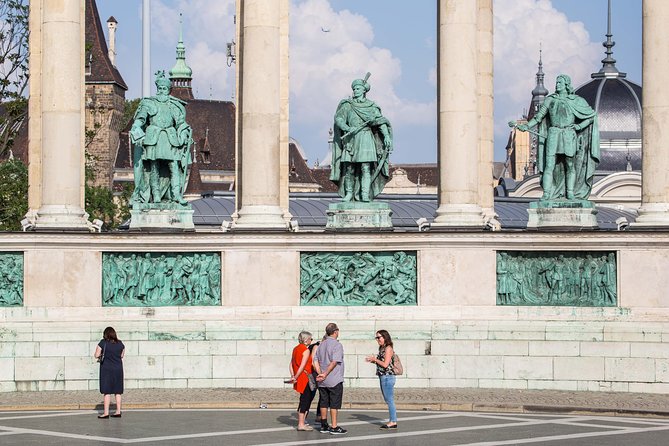
The route continues toward Heroes Square, one of Budapest’s major ceremonial spaces. Its monuments honor important figures from Hungarian history, so it gives you a quick introduction to the country’s official version of its past.
That phrase matters. A strong guide can explain not just who appears on a monument, but also how national memory changes under different governments. One especially praised guide, Aniko, was noted for explaining both accepted accounts and disputed interpretations of Hungarian history. That sort of context is valuable because monuments rarely tell the whole story.
The walk includes a short ride on continental Europe’s oldest metro line. This is one of the tour’s most practical features. Budapest is spread out, and covering every section on foot would make the afternoon even harder on your legs. The metro ride also lets you use a piece of the city’s daily transport system rather than viewing Budapest only from the pavement.
The tour does not present the metro ride as a separate attraction with a long station-by-station visit. It is a brief public-transport link within the route. Still, it breaks up the walking and gives you a useful first lesson in getting around Budapest.
More things to do in Budapest:
- Budapest: City Highlights Cruise with Welcome Drink
★ 4.6 · 35,610 reviews - Budapest: Unlimited Prosecco, Beer and Aperol Spritz Cruise
★ 4.8 · 25,310 reviews - Budapest: Széchenyi Spa Day Ticket with Optional Upgrades
★ 4.3 · 23,911 reviews - Budapest: Nighttime or Daytime Sightseeing Cruise
★ 4.2 · 21,062 reviews
Entering the former Jewish Quarter
The former Jewish Quarter brings a different mood and a more difficult chapter of the city’s past. The tour passes the Great Synagogue, described as the largest in Europe, then continues through Gozsdu udvar and along Király utca.
Gozsdu udvar is a complex of seven connected buildings and courtyards in the seventh district. Its shops and restaurants make it one of the area’s liveliest places, but the importance of the stop is not only social. The courtyards and streets help you understand the former Jewish district as an urban neighborhood, not simply as a religious landmark.
You should note that seeing the Great Synagogue from the outside is not the same as taking a dedicated synagogue visit. If you want the interior, museum, and Holocaust exhibitions, you will need separate time and admission. The walking tour gives you useful orientation and historical context, then keeps moving.
This section is especially worthwhile if you want your introduction to Budapest to include the city’s Jewish heritage and wartime losses. The route does not reduce the neighborhood to nightlife or architecture. It places the surviving buildings and modern street life beside the memory of what was destroyed.
Liberty Square and the politics of public memory
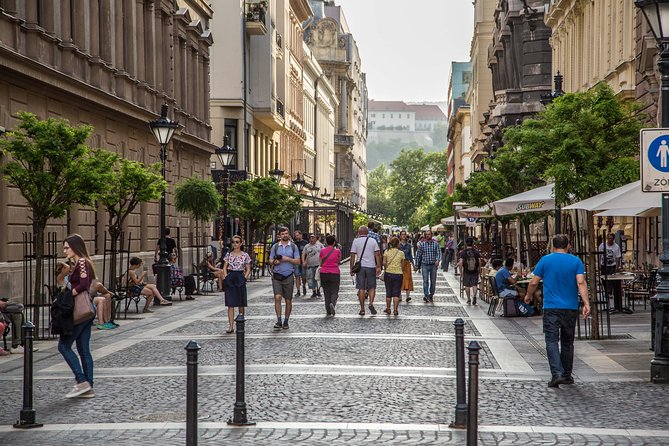
The walk also reaches Liberty Square, a handsome open space surrounded by important buildings, including the former stock exchange. It is a good example of how Budapest’s public spaces carry several layers of political meaning.
You may see monuments connected with the United States, the Soviet period, and later Hungarian politics. The route includes discussion of the Soviet Monument, a memorial to a US major, and a memorial connected with Ronald Reagan. Those details can seem surprising until a guide explains the political arguments and historical events behind them.
This is where a local guide adds real value. A quick photograph tells you what a monument looks like. A person who knows the city can explain why it is there, what it commemorates, and why people may view it differently.
The Hungarian Academy of Sciences appears nearby in an elegant neoclassical palace built in 1865. Again, the tour focuses on the exterior and the story of the institution rather than an extended interior visit. It is a pleasing architectural pause before the route reaches the river.
The Danube promenade and the Shoes on the Danube
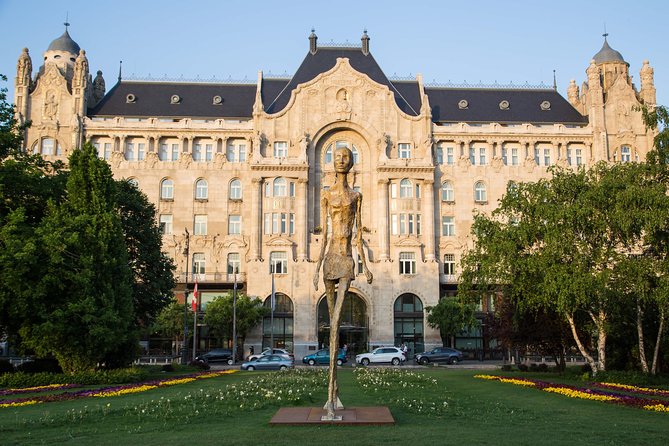
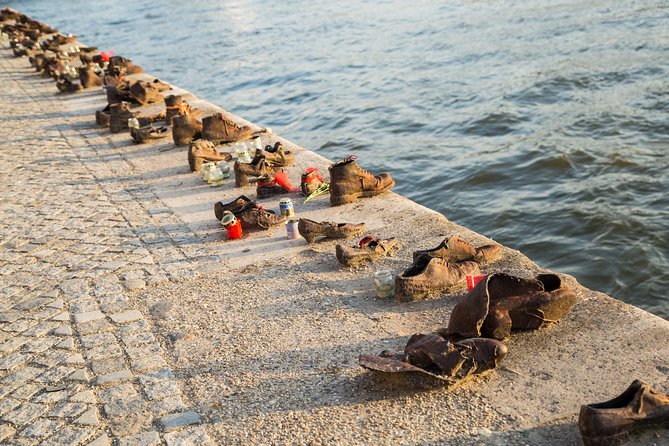
The final stretch by the Danube is the emotional center of the tour. The Shoes on the Danube Memorial honors Jewish people who were killed along the river during the Holocaust. The iron shoes placed on the promenade are stark, simple, and hard to forget.
This is not a stop to rush through. Your guide can provide the historical setting, but the memorial needs a quiet moment as well. The tour’s inclusion of it gives the afternoon more weight than a sightseeing loop built only around beautiful façades.
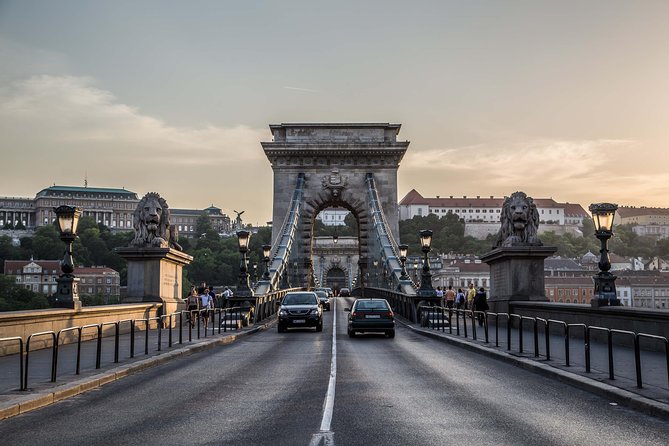
From the riverbank, you also get wide views of the neo-Gothic Parliament building, the Chain Bridge, and Buda Castle. The Hungarian Parliament dominates the opposite stretch of the Pest-side riverfront, while the bridges show how closely Buda and Pest depend on one another.
The Hungarian Academy of Sciences and the river bridges add an urban frame to the view. You are not only looking at monuments. You are seeing the city’s civic institutions, transport links, and riverfront life in one sweep.
The tour ends near Chain Bridge on the Pest side. Your guide departs there, so this is a useful place to continue independently. You can cross toward Buda, begin your own visit to Buda Castle, or stay on the Pest side for more riverfront exploring. The tour does not include a guided Buda Castle visit, so plan another block of time if that is high on your list.
Pace, group size, and what the $125 covers

At $125 per person, this is not a cheap orientation walk. The value comes from the amount of ground covered, the local guide, the small group, the wine, the café drink, and the public-transport rides.
The shared group is limited to 2 to 8 people. That is small enough for questions and conversation, though eight people can still create a little stop-and-start movement in crowded streets. Larger groups have a separate option, while a private tour can be customized for your group and interests.
The tour includes:
- An English-speaking local guide
- Hungarian sparkling wine at the start
- One coffee or another drink during the café break
- Short public-transport rides, including the historic metro line
- Time for photographs and questions
The café stop comes roughly two-thirds of the way through the tour. One highly praised guide, Aniko, was described as adding dessert and lemonade for a private group, and even covering the coffee and cake. That extra generosity should not be treated as a guaranteed inclusion, but it shows how a private guide may adjust the experience to the people in front of her.
The listed inclusion is one coffee or drink. If you do not drink coffee, the experience can accommodate another choice, as the tour includes coffee and tea and a direct account described lemonade and dessert as substitutes. Tell your guide at the start if you have a preference.
The tour often runs beyond four hours when the group is not in a hurry. If you have a dinner reservation, concert, or train, say so at the beginning. The guide can then watch the clock rather than letting the walk grow into a five-hour city marathon.
Who should book the Budapest Grand Walk
I would choose this tour for a first full day in Budapest, especially if you want an overview before choosing which museums and interiors deserve your own time. It suits people who enjoy history, architecture, city politics, and conversation more than people who want a relaxed café afternoon.
It is also a good match for couples or small groups who want a private option. The private format may be worth the extra cost if you have a strong interest in Jewish Budapest, the 1956 Revolution, architecture, wine, or a particular neighborhood. Tell the local provider your preferred theme when booking so the walk can be adjusted.
You should be ready for a moderate amount of walking over four hours. Wear comfortable shoes, carry water, and avoid scheduling something immediately afterward. The route includes public transport, but much of the experience is on foot.
The tour is offered in English. Confirmation arrives at booking, but a minimum of two participants applies. If that minimum is not met, the experience may be canceled and you will be offered another date or a full refund. The booking is otherwise non-refundable and cannot be changed, so choose your date carefully.
Should you book it?
Book the Budapest Grand Walk if you want a serious, wide-ranging introduction to Pest with a personal guide, a drink in hand, and a useful finish by the Danube. The strongest reason to choose it is the storytelling. Guides such as Aniko and Angela have been praised for warmth, excellent English, flexibility, and the ability to make centuries of Hungarian history understandable.
Skip it if you prefer slow museum visits, dislike long walks, or mainly want to see Buda Castle from the inside. For most first-time visitors who want to get their bearings fast, the $125 cost can make sense, particularly in a small or private group. Start early in your stay, keep the evening open, and let the walk shape the rest of your Budapest plans.
FAQ
How long does the Budapest Grand Walk last?
The tour lasts approximately four hours. It may run longer if the group is not in a hurry, so tell the guide at the start if you need to finish by a specific time.
Where does the tour begin?
The meeting point is Tasting Table Budapest, a wine shop and cellar at Bródy Sándor u. 22 in Budapest’s Palace district.
Where does the tour end?
The tour ends near Chain Bridge on the Pest side of the Danube. You can cross the bridge afterward and continue exploring Buda Castle independently.
Is food or drink included?
A glass of Hungarian sparkling wine is included at the start, along with one coffee or another drink during the café break. Coffee and tea are listed among the included refreshments.
How many people can join the shared tour?
The shared small-group tour takes between 2 and 8 people. Larger groups and private tours are available as separate options.
Is the tour suitable for people who do not drink coffee?
Yes. One drink is included during the café break, and the experience includes coffee and tea. A supplied account also describes lemonade being chosen instead of coffee, so you can tell the guide your preference.
Just added in Budapest
- Budapest: Private Walking Tour with a Local Guide★ 3.6 · 6 reviews
- Budapest: Danube River Views Bike Ride★ 4.8 · 23 reviews
- Budapest: City Bike Tour with Coffee Stop★ 5.0 · 37 reviews
- From Budapest: Guided Tour of Eger with Wine Tasting★ 4.5 · 6 reviews
- Walk to recent and aged spiritual sanctuaries near Budapest★ 5.0 · 5 reviews
- Walking consultancy with alternative psychologist and author★ 5.0 · 2 reviews
- Budapest: Guided Tour of the Parliament Building in Spanish★ 4.6 · 1,240 reviews
- Budapest: 3-Hour Trabant Sightseeing Tour★ 4.7 · 28 reviews
Walking Tours, compared.
Budapest City Landmarks Walking Tour in 2 Hours
Read our review →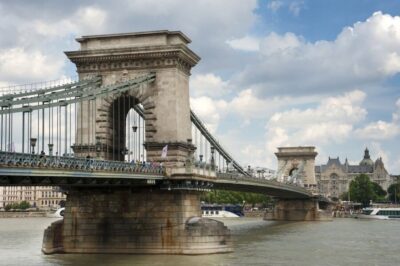
3-Hour Orientation Walking Tour of Buda and Pest
Read our review →
Budapest Historical Sightseeing – Free Walking Tour
Read our review →
Budapest All in One Small Group Walking Tour with Strudel Stop
Read our review →
Buda Castle District Walking Tour with a Historian
Read our review →
BloodThirsty Hungary: Walking tour & Dark Historical Stories
Read our review →Browse the lists this tour appears in