
REVIEW · JEWISH HERITAGE TOURS
A Journey through Jewish Budapest – Walking Tour
History comes alive on Budapest’s streets. This three-hour walk links the city’s major Jewish landmarks with the stories that give them meaning, from the grand Dohány Street Synagogue to the quiet Shoes on the Danube memorial. I especially like the small-group format, which allows room for questions, and the guides’ strong academic background, praised by past participants who toured with Orsolya, Veronika, Agi, and Endre. I also like that the tour connects religious buildings with daily life, food, Hungarian history, and the tragedy of World War II. The main consideration is cost: at $126.16 per person, you still pay separately for synagogue and museum admission.
This is a thoughtful choice if you want more than a quick walk through Budapest’s Jewish Quarter. You should dress with care, since shoulders and knees must be covered at the Dohány and Kazinczy synagogues. Also note that the details describe the group both as limited to six people and as having a maximum of eight, so confirm the final group size when booking.
In This Review
- Key points to know before you go
- Why this tour gives Budapest’s Jewish Quarter context
- Starting opposite the Great Synagogue
- Kazinczy Street and the former Ghetto Wall
- Rumbach Street and the Status Quo Ante tradition
- Finishing at the Shoes on the Danube
- What the guides add to the experience
- Price, tickets, and the real value
- Timing, clothing, and walking practicalities
- Who should book this walk
- Should you book A Journey Through Jewish Budapest?
- FAQ
- How long is A Journey Through Jewish Budapest?
- Where does the tour begin?
- What time does the tour start?
- Where does the tour end?
- Is hotel pickup available?
- Are synagogue admission tickets included?
- Is food included?
- Can I enter all three synagogues?
- What should I wear?
- How many people can join the tour?
Key points to know before you go
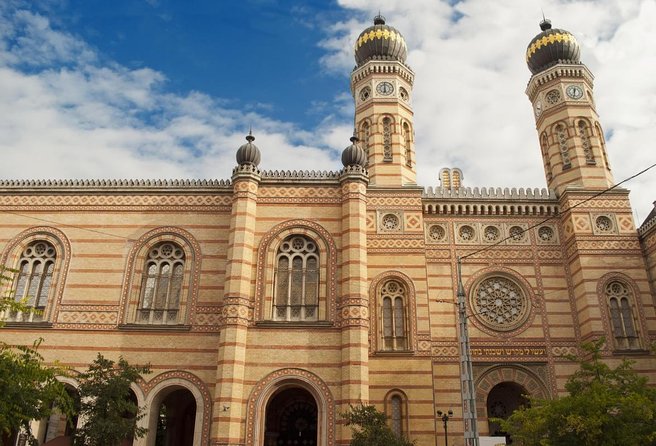
- Three synagogues form the core of the walk: Dohány Street, Kazinczy Street, and Rumbach Street each represent a different Jewish tradition and architectural style.
- The tour ends at the Shoes on the Danube memorial: This gives the walk a serious, reflective finish rather than ending in the middle of the entertainment district.
- Guides bring strong academic and cultural background: Orsolya is praised for connecting Jewish history with Hungarian history and local food, while Agi, Endre, and Veronika received similar praise for clear, moving explanations.
- Admission is not included: You pay separately for the Dohány, Kazinczy, and Rumbach synagogue tickets, along with any Jewish Museum entry.
- Morning and afternoon departures are offered: The listed start time is 10:00 a.m., and the walk lasts about three hours.
- The advertised route needs a careful reading: Buda Castle, the former Pest Ghetto, and Óbuda Synagogue appear in the highlights, but the timed route provided focuses on the three Pest synagogues and the Danube memorial.
Why this tour gives Budapest’s Jewish Quarter context
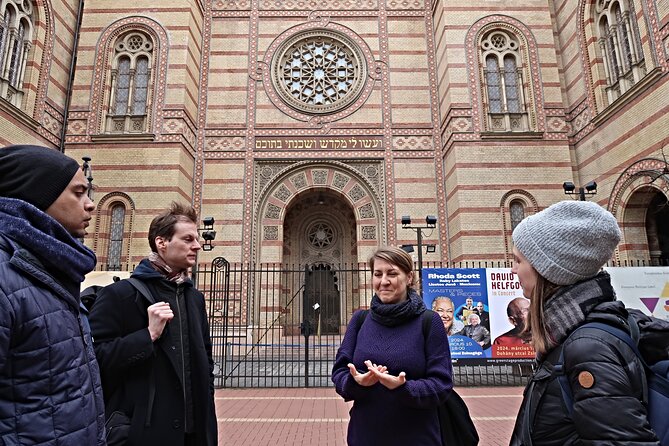
Budapest’s Jewish Quarter is easy to visit on your own, but it is not always easy to understand. The streets mix cafés, apartments, memorials, synagogues, and reminders of wartime persecution. Without explanation, you can look at a beautiful façade and miss the religious divisions, community life, and political forces behind it.
This tour gives you a historian guide for roughly three hours. That matters because the route is not just a checklist of buildings. You move from the largest synagogue in Europe to smaller places of worship, then toward the Danube, where the mood changes sharply.
I like this progression. It shows Jewish Budapest as a living community with several traditions, not only as a place defined by wartime suffering. The guide’s job is to connect architecture and memory, and the strongest comments about Orsolya, Agi, Endre, and Veronika suggest that this human explanation is the chief reason to book.
The small group should help. The information says the tour is limited to six people, while the additional details set a maximum of eight. Either way, this is far more personal than a large coach outing. You can ask about religious customs, neighborhood life, Hungarian history, or the synagogues’ different roles without trying to catch a guide’s voice from the back of a crowd.
More Jewish heritage tours:
- Budapest Jewish Heritage Memorial Walking Tour & Synagogue Entry
★ 5.0 · 568 reviews - Budapest: Jewish Heritage Guided Tour with Synagogue Ticket
★ 4.8 · 533 reviews - Jewish Quarter of Budapest Walking Tour
★ 4.7 · 369 reviews
Starting opposite the Great Synagogue
The meeting point is Kamara Café at Dohány Street 1a or 1b, directly opposite the Great Synagogue. The listed start time is 10:00 a.m. Pickup is offered, but the published meeting instructions specifically identify the café as the starting point, so check your confirmation for the exact arrangement.
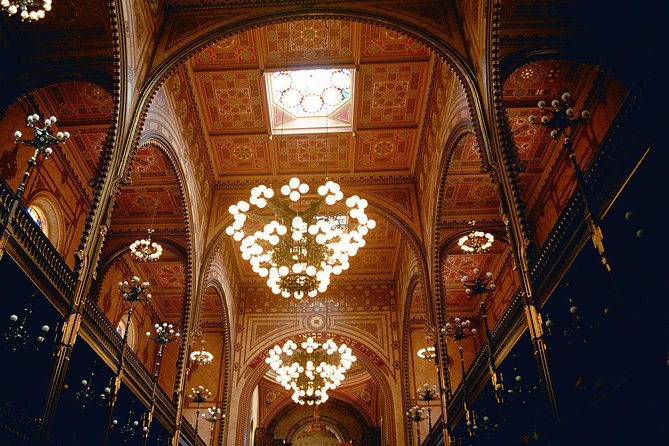
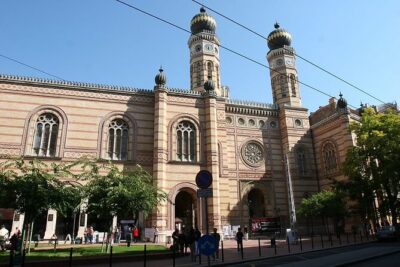
The Dohány Street Synagogue is the natural place to begin. Its Moorish Revival design is lavish, and the scale immediately tells you that this was once, and remains, a major center of Jewish life in Budapest. The tour allows about 30 minutes here.
Inside the wider complex, you can see the Temple of Heroes, the Jewish Museum, and a memorial park. These additions matter because they broaden the visit beyond the main prayer hall. You get religious architecture, museum material, and public remembrance in one setting.
There is one practical catch: admission is not part of the tour price. The itinerary lists the Dohány Synagogue ticket as excluded, so budget for it separately. The same applies to the Jewish Museum if its admission is charged separately. The guide can explain what you are seeing, but the ticket remains your responsibility.
I would treat this first stop as the architectural and historical anchor of the morning. If you arrive early, use the time to orient yourself outside the synagogue and make sure your clothing meets the shoulder and knee requirement.
Kazinczy Street and the former Ghetto Wall
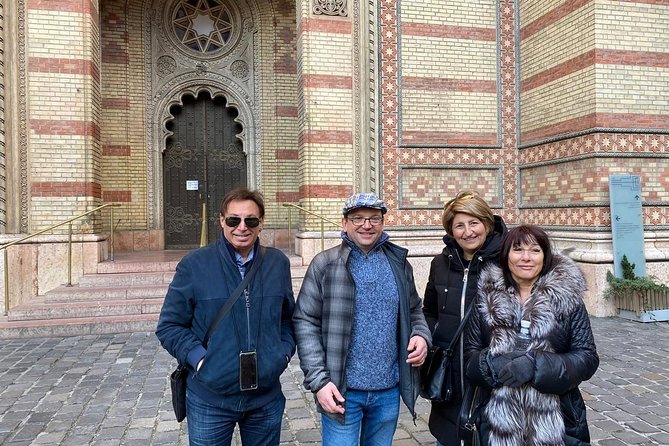
From Dohány Street, the walk continues to Kazinczy Street. Before entering the synagogue, the route passes the Ghetto Wall Memorial, erected in 2014. This is a useful point in the walk because it places the neighborhood’s wartime story in the same streets where community life continues today.
The route also passes a luxurious mikve, or Jewish ritual bath. The detail is easy to overlook on a self-guided walk, yet it helps explain that Jewish life is shaped by religious practice as well as by grand public buildings. A guide can give this kind of detail a proper place in the larger story.
Kazinczy Street Synagogue is an Art Nouveau Orthodox synagogue. That style and religious identity offer a clear contrast with Dohány Street. The tour allots about 35 minutes here, the longest scheduled synagogue stop.
The interior visit depends on opening hours. If the synagogue is open to the public, you go inside with the guide. If not, you should expect an exterior explanation rather than a guaranteed interior visit. Admission is also excluded, and the shoulder and knee dress rule applies.
This stop is likely to suit you if you want to understand the differences within Budapest’s Jewish community. You are not simply seeing three versions of the same building. The route introduces different religious streams and shows how close they are to one another in the city.
Rumbach Street and the Status Quo Ante tradition
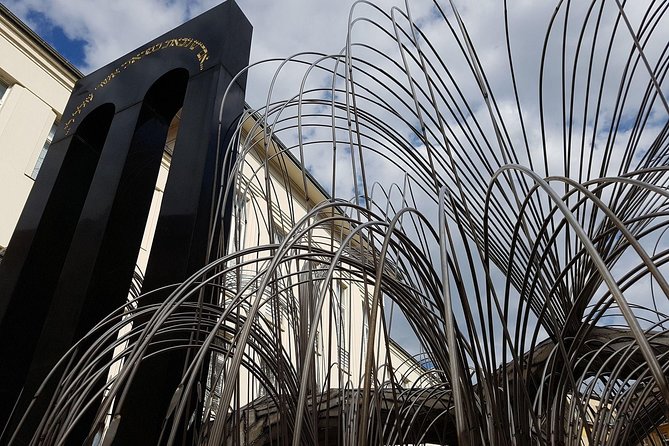
Rumbach Street Synagogue brings another layer to the story. The guide explains the Status Quo Ante stream of Judaism while you observe the synagogue. The scheduled time is about 25 minutes.
The itinerary says the interior is visited when the building is open to the public. That wording is important. You should not book this walk assuming that every synagogue interior is guaranteed. The route is designed around access, but access can depend on opening conditions.
Rumbach also gives the tour a chance to compare architecture and community identity across a short distance. Dohány, Kazinczy, and Rumbach are close enough to connect on foot, yet each points to a different part of Budapest’s Jewish religious history.
I like the way this section prevents the tour from becoming a single-building visit. A grand synagogue can make a powerful impression, but three traditions give you a much clearer sense of the community’s internal variety.
The separate admission costs matter here too. Tickets for Rumbach Street Synagogue are not included in the $126.16 tour price. Ask at booking or before the walk how the guide handles the stops if one interior is closed, since the supplied details only promise interior access when open to the public.
More walking tours in Budapest:
- Budapest: Buda Castle Walk with Saint Stephen’s Hall
★ 4.5 · 3,012 reviews - Big Bus Budapest Hop-On Hop-Off Bus and Walking Tour
★ 3.5 · 2,206 reviews - Budapest: Buda Castle District Walking Tour
★ 4.6 · 2,108 reviews - Budapest City Landmarks Walking Tour in 2 Hours
★ 5.0 · 2,048 reviews
Finishing at the Shoes on the Danube
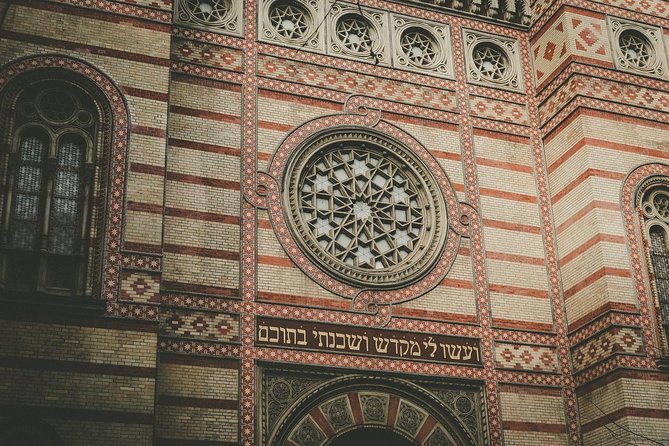
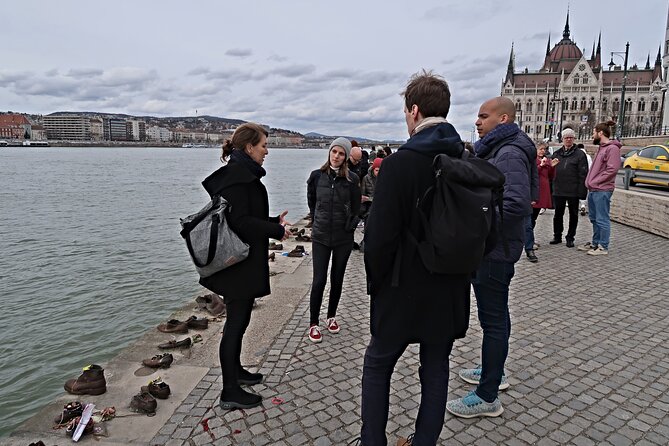
The final stop is the Shoes on the Danube Bank memorial, and the tone changes completely. The memorial honors Jews murdered during World War II who were ordered to remove their shoes before being shot at the river’s edge. Their bodies fell into the Danube, leaving the shoes behind as the memorial’s central image.
The memorial was erected on April 16, 2005. The tour allows about 20 minutes here, which is enough time for the guide to explain the event and for you to pay respects without rushing through the site.
I think this is a strong ending because the tour does not finish with shopping, cafés, or a return to the starting point. It ends at a place that asks for quiet attention. After the synagogues and community history, you reach a memorial that makes the violence of the period painfully direct.
The end point is listed at Shoes on the Danube Bank, in the 1054 area of Budapest. You are not returned to Kamara Café, so plan your next move from the riverfront. The memorial itself is free, and no extra ticket is required.
What the guides add to the experience
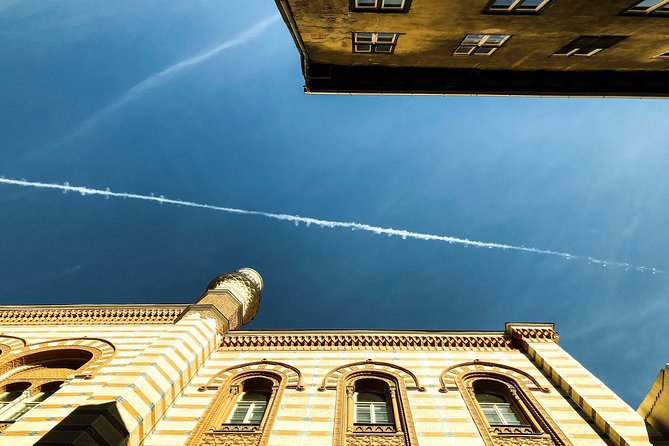
The guide is the main value of this walk. A building such as Dohány Synagogue can impress you on sight, but the guide explains why it matters, how the community developed, and how the separate religious traditions fit together.
Orsolya receives especially strong praise for combining Jewish history with the wider story of Hungary. She also brought culinary knowledge into the conversation, including a recommendation for flódni, a traditional Jewish-Hungarian cake. That kind of advice can make the walk feel connected to present-day Budapest instead of locked in the past.
Agi is praised for explaining the three synagogues, the Jewish Museum, and the surrounding neighborhood in a way that built a clear picture from one stop to the next. Endre is described as attentive and highly informed, with an ability to find many useful points of interest around the Jewish Quarter. Veronika is praised for presenting the painful wartime history with care and clarity.
You should not assume you will receive a particular guide, but these names give you a useful sense of the guiding team. The most repeated strength is not entertainment. It is the ability to explain difficult history accurately while keeping the group engaged.
Price, tickets, and the real value
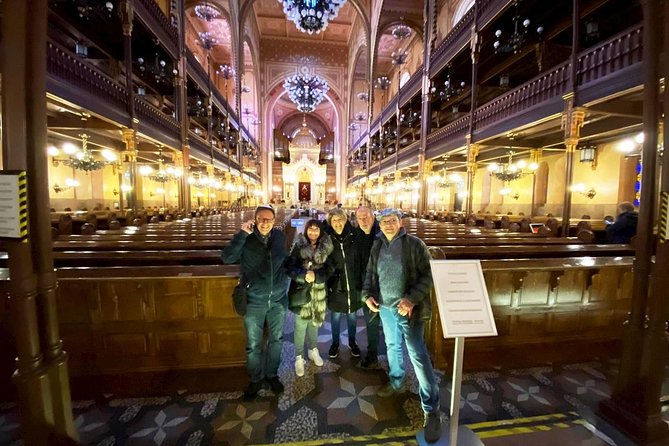
At $126.16 per person, this is not a cheap Budapest walking tour. The price is easier to justify if you want an academic guide, a very small group, and a focused subject rather than a general city stroll.
Still, the included package is limited to the three-hour guided walk and historian guide. Food, drinks, and synagogue tickets are extra. Since the route may include the Dohány, Kazinczy, and Rumbach interiors when they are open, you should calculate the likely total before booking.
I would compare the price with your priorities. If you only want to see the exteriors and take a few photographs, the cost will feel high. If you want the religious background, the wartime context, and an explanation of why the three synagogues differ, the guide may provide value you cannot easily get from signs or a map.
The tour is booked about 49 days ahead on average, which suggests you should not leave it until the last day of a short Budapest visit. The small-group format may fill earlier than a standard city walk.
Timing, clothing, and walking practicalities
The listed duration is approximately three hours, with a 10:00 a.m. start and morning or afternoon departure options. Since the route ends at the Danube rather than returning to the café, leave space afterward for lunch, the riverfront, or another central Budapest sight.
The tour is a walking activity and begins near public transportation. Most people can participate according to the supplied accessibility information. No special mobility details are provided, so if you have a concern about walking for three hours, ask the operator before booking.
Dress is one of the easiest details to miss. Shoulders and knees should be covered when visiting the Dohány and Kazinczy synagogues. I would choose respectful clothing from the start rather than rely on a last-minute cover-up.
Pickup is offered, but the stated pickup location is Kamara Café, right opposite the Great Synagogue. After booking, you receive the guide’s photo, phone number, and biography. Save those details so you can identify the guide and reach them if you have trouble locating the café.
Who should book this walk
I would recommend this tour most strongly if you want to understand Budapest’s Jewish community across time. It suits history-minded visitors, people with family connections to Jewish Europe, and anyone who prefers a guide who can explain architecture, religion, food, and wartime memory in one continuous route.
It also works well for families with older children who can handle serious subject matter and three hours on foot. The small group should make it easier to pause for questions and adjust the level of detail.
You may want a different option if your main goal is a quick neighborhood orientation, guaranteed entry into every synagogue, or a low-cost activity. The interior visits depend on public opening, and the separate admission fees increase the total cost.
Also read the route details carefully if Buda Castle or Óbuda Synagogue is important to you. They appear in the tour highlights, but the timed route supplied here lists Dohány, Kazinczy, Rumbach, and the Shoes on the Danube. Ask for clarification before booking if you expect a visit to those other sites.
Should you book A Journey Through Jewish Budapest?
Book it if you want a serious, carefully explained look at Jewish Budapest and are willing to pay extra for admissions. The strongest reasons are the small group, the historian guide, the three distinct synagogues, and the meaningful finish at the Shoes on the Danube.
I would skip it if you prefer a general sightseeing walk or need a tightly fixed itinerary with guaranteed interior access. For the right audience, though, this is a focused and worthwhile way to understand a part of Budapest that deserves more than a quick photograph.
Free cancellation is available up to 24 hours before the start time, giving you some flexibility. Just remember that changes or cancellations within 24 hours are not accepted for a refund.
FAQ
How long is A Journey Through Jewish Budapest?
The walking tour lasts approximately three hours.
Where does the tour begin?
It begins at Kamara Café on Dohány Street, directly opposite the Great Synagogue in Budapest.
What time does the tour start?
The listed start time is 10:00 a.m. Morning and afternoon departure options are offered.
Where does the tour end?
The tour ends at the Shoes on the Danube Bank memorial.
Is hotel pickup available?
Pickup is offered, but the provided pickup details identify Kamara Café as the pickup location. Check your booking confirmation for the exact arrangement.
Are synagogue admission tickets included?
No. Admission to the Dohány, Rumbach Street, and Kazinczy Street synagogues is not included.
Is food included?
No. Food and drinks are not included in the tour price.
Can I enter all three synagogues?
Interior visits take place when the synagogues are open to the public. Interior access is therefore not guaranteed at every stop.
What should I wear?
Visitors to the Dohány and Kazinczy synagogues are requested to cover their shoulders and knees.
How many people can join the tour?
The tour is described as a small-group experience limited to six people, while the additional information gives a maximum of eight travelers. Confirm the final group size when booking.
Just added in Budapest
- Budapest: Private Walking Tour with a Local Guide★ 3.6 · 6 reviews
- Budapest: Danube River Views Bike Ride★ 4.8 · 23 reviews
- Budapest: City Bike Tour with Coffee Stop★ 5.0 · 37 reviews
- From Budapest: Guided Tour of Eger with Wine Tasting★ 4.5 · 6 reviews
- Walk to recent and aged spiritual sanctuaries near Budapest★ 5.0 · 5 reviews
- Walking consultancy with alternative psychologist and author★ 5.0 · 2 reviews
- Budapest: Guided Tour of the Parliament Building in Spanish★ 4.6 · 1,240 reviews
- Budapest: 3-Hour Trabant Sightseeing Tour★ 4.7 · 28 reviews
Jewish Heritage Tours, compared.
Budapest Jewish Heritage Memorial Walking Tour & Synagogue Entry
Read our review →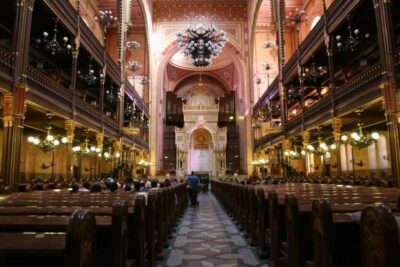
Jewish Heritage Guided Tour with Synagogue Ticket
Read our review →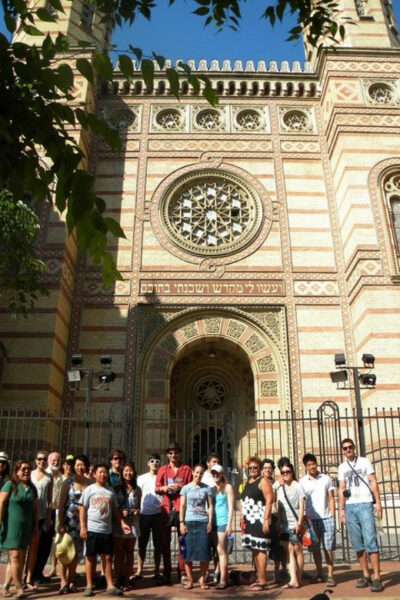
Past and Present of Budapest Jewish District Tour
Read our review →
Budapest Dohany Synagogue & Hungarian Jewish Museum & free extras
Read our review →
Jewish History Guided Walking Tour with Historian
Read our review →Browse the lists this tour appears in