
REVIEW · JEWISH HERITAGE TOURS
A Journey through Jewish Budapest – Walking Tour
Budapest’s Jewish quarter rewards careful attention. This three-hour walk connects the city’s Jewish past with places of worship, wartime memory, and today’s renewed community. I like the historian-led approach, and I like that the route includes several Jewish traditions rather than focusing only on the Holocaust.
The tour is especially strong when your guide adds personal care to the history. Orsolya has been praised for her thoughtful, thorough explanations, while Endres has led detailed visits around the Great Synagogue and even helped participants clean Stolpersteine, or stumbling stones, honoring Holocaust victims. The main drawback is cost: at $123 per person, you still pay separately for entry to the Dohány Synagogue, listed at 14,500 Hungarian forints.
In This Review
- Key points to know before you book
- Why Jewish Budapest needs more than one story
- Starting near Madách Imre Way and Theodor Herzl
- Entering the Dohány Street Synagogue complex
- The Ghetto Wall Memorial and the missing boundary
- Kazinczy Street and the Orthodox Jewish tradition
- Rumbach Street and the Status Quo Ante community
- Ending at Shoes on the Danube Bank
- The guide can make or break this experience
- Is $123 a fair price?
- Timing, pace, and practical planning
- Who should book this walking tour?
- Should you book A Journey Through Jewish Budapest?
- FAQ
- How long is the Jewish Budapest walking tour?
- What language is the tour offered in?
- Is the Dohány Synagogue admission included?
- What should I wear to the Dohány Synagogue?
- Where does the tour begin?
- Is the tour private or shared?
Key points to know before you book
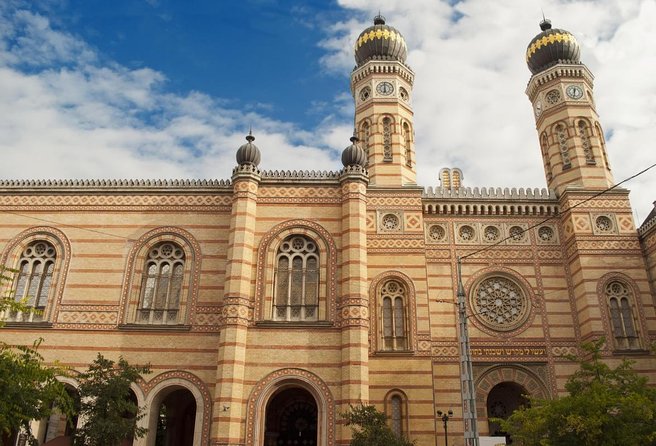
- A three-hour walk through several Jewish traditions: You visit the Dohány, Kazinczy, and Rumbach synagogues, each linked to a different strand of Jewish life in Budapest.
- The Dohány Synagogue visit is the centerpiece: Your historian guide helps explain the Moorish Revival design, Temple of Heroes, Jewish Museum, and Memorial Park.
- The route connects memory with modern Budapest: The Ghetto Wall Memorial and Shoes on the Danube Bank give the wartime story a clear, human focus.
- Small groups make a real difference: Private and small-group options allow room for questions and, in some cases, a flexible pace.
- Dress matters at Dohány: Your shoulders and knees should be covered for entry.
- The tour suits serious history readers: Guides may be professors, doctoral students, historians, journalists, art critics, or published authors.
Why Jewish Budapest needs more than one story
Before World War II, roughly one quarter of Budapest’s population was Jewish. That number alone tells you why a short walk through the old Jewish quarter can feel dense with meaning. Jewish life here was not one single experience, and this tour makes that point early.
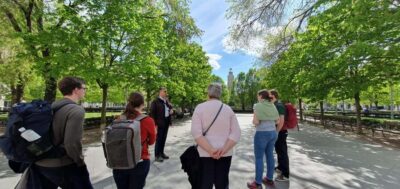
You begin near Madách Imre Way, at the square connected with Theodor Herzl, the father of modern Zionism. Herzl was born in Budapest, and starting near his birthplace gives the tour a useful frame. You are not beginning with wartime destruction. You are beginning with Jewish intellectual, religious, and civic life before the catastrophe.
That matters. If you only visit memorials, you can leave with a picture of Jewish Budapest as a vanished world. This route also shows a community with different religious currents, grand buildings, ritual spaces, and public figures. The result is more balanced and more human.
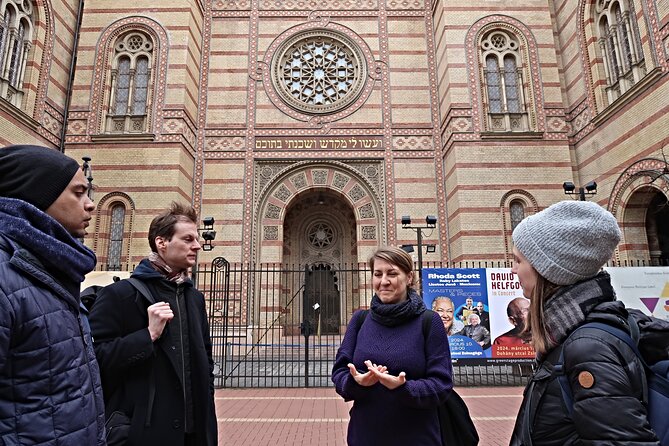
Your guide’s role is central. This is not simply a walk from one facade to the next. A strong guide can explain why different congregations developed, how the Jewish quarter functioned, and how daily life changed under Nazi rule. The available guide team includes academic and publishing backgrounds, so this experience is best for you if you enjoy context, questions, and careful explanation.
More Jewish heritage tours:
- Budapest Jewish Heritage Memorial Walking Tour & Synagogue Entry
★ 5.0 · 568 reviews - Budapest: Jewish Heritage Guided Tour with Synagogue Ticket
★ 4.8 · 533 reviews - Jewish Quarter of Budapest Walking Tour
★ 4.7 · 369 reviews
Starting near Madách Imre Way and Theodor Herzl
The meeting point is Kamara Café at Dohány utca 1/A. From there, the tour moves toward Madách Imre Way and the square associated with Theodor Herzl’s birthplace.
This first stop is less about a grand monument and more about orientation. You begin by placing Budapest’s Jewish story in a wider European setting. Herzl’s later role in modern Zionism gives the opening a political and intellectual angle, while the surrounding streets begin to show the urban setting in which Jewish life developed.
I appreciate this kind of start because it avoids rushing straight into tragedy. You get a sense of people, ideas, and institutions before the tour turns to persecution and loss.
Entering the Dohány Street Synagogue complex
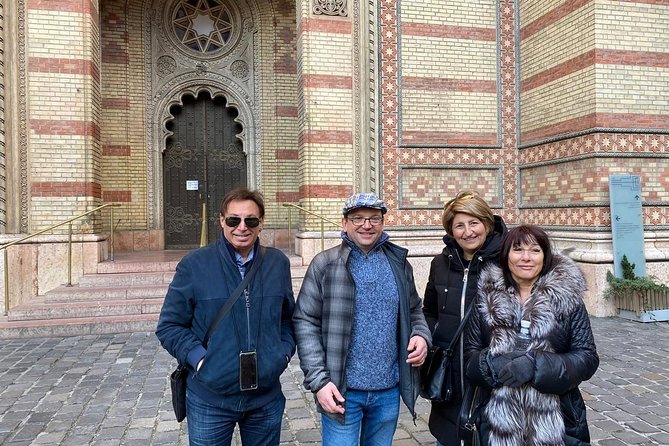
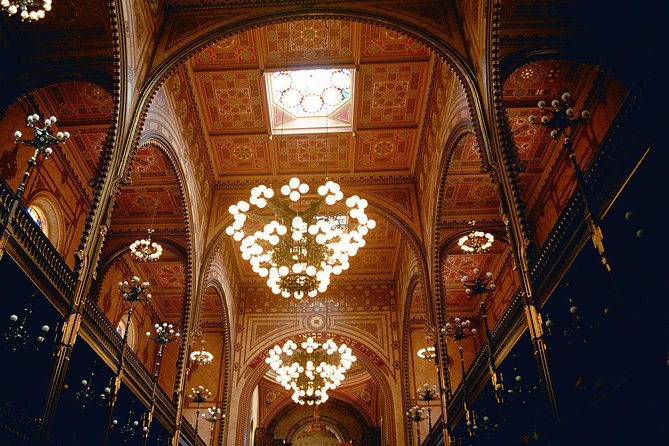
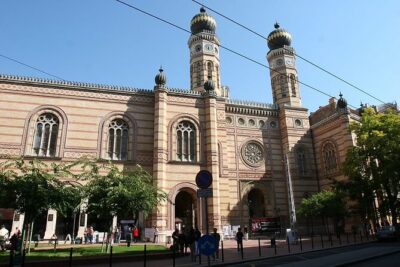
The Dohány Street Synagogue is the major admission site on the route and the tour’s architectural high point. It is described as the largest Jewish house of worship in Europe, and its Moorish Revival design gives the building an unusually grand appearance.
Expect the interior and exterior to take time. Your guide, supported by Jewish Studies training, can explain the building’s religious and cultural role rather than treating it as a pretty photo stop. The design is lavish, but the important question is what that grandeur tells you about the confidence and public presence of Budapest’s Jewish community before the war.
The complex includes more than the main synagogue. You also visit the Temple of Heroes, the Jewish Museum, and a Memorial Park. Each adds a different layer:
- The synagogue introduces religious practice, architecture, and communal identity.
- The Temple of Heroes connects Jewish memory with wartime loss.
- The Jewish Museum provides objects and historical material that make the story less abstract.
- Memorial Park gives you space to reflect on the destruction of the community.
The separate admission fee is the key practical issue here. Tickets to the Dohány Synagogue are not included and are listed at 14,500 forints per individual. Add that to the $123 tour price when you compare the total cost with other Budapest walks.
You should also dress with the synagogue’s rules in mind. Visitors are requested to cover their shoulders and knees. This is easy to manage, but it is worth planning before you leave your hotel.
The Ghetto Wall Memorial and the missing boundary
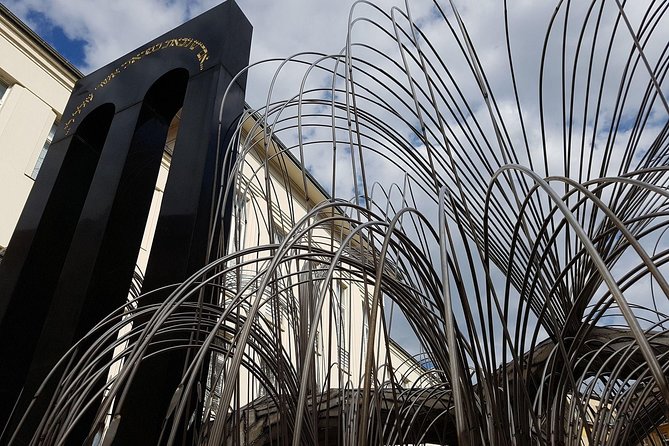
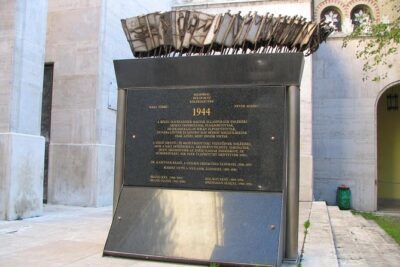
After Dohány, you walk to the nearby Ghetto Wall Memorial, erected in 2014. The route changes tone here. The synagogue complex presents a visible center of Jewish life, while the wall points toward confinement, separation, and the forced reshaping of the neighborhood.
This is a useful stop because it helps you picture the ghetto as a lived urban space rather than a distant chapter in a textbook. Budapest’s wartime persecution happened along ordinary streets, near homes, shops, religious buildings, and public routes. The memorial encourages you to think about how quickly familiar surroundings can become instruments of control.
The wall is not an ancient structure, and that is part of its meaning. It is a modern marker for a boundary that shaped lives and was later removed. Your guide can connect the site with the broader wartime story without letting the memorial become a quick photograph between synagogue visits.
More walking tours in Budapest:
- Budapest: Buda Castle Walk with Saint Stephen’s Hall
★ 4.5 · 3,012 reviews - Big Bus Budapest Hop-On Hop-Off Bus and Walking Tour
★ 3.5 · 2,206 reviews - Budapest: Buda Castle District Walking Tour
★ 4.6 · 2,108 reviews - Budapest City Landmarks Walking Tour in 2 Hours
★ 5.0 · 2,048 reviews
Kazinczy Street and the Orthodox Jewish tradition
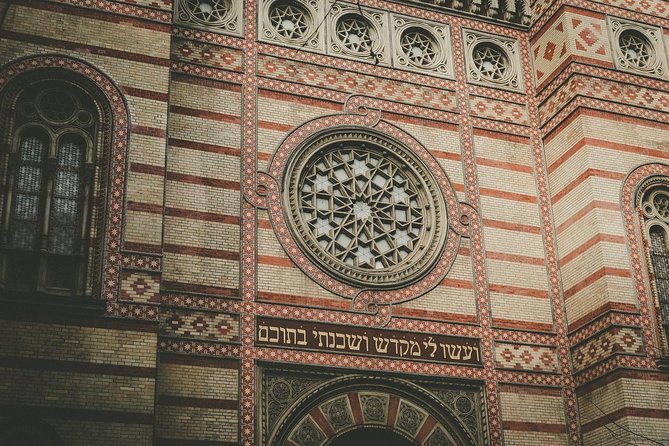
The tour continues past a luxurious mikve, or Jewish ritual bath, and then to the exterior of the Art Nouveau Orthodox synagogue on Kazinczy Street. Since the information provided describes this as an exterior visit, you should not expect the same interior experience you receive at Dohány.
Still, the stop has real value. The route uses Kazinczy Street to explain the Orthodox stream of Judaism and to show that Budapest’s Jewish population was divided into different religious communities. The synagogue facade gives you a visible reminder of those differences, while the mikve points to the practical side of religious life.
This section may appeal most to you if you like architecture and social history. It is not only about how buildings look. It is about why separate congregations required their own places, customs, and institutions.
Rumbach Street and the Status Quo Ante community
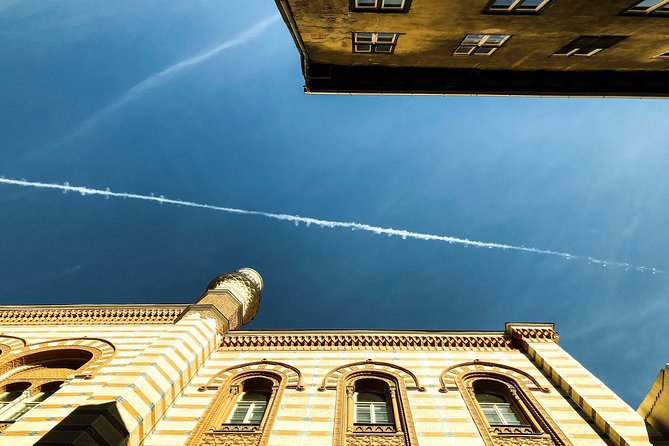
The Rumbach Street Synagogue is another important architectural stop. Here, the focus shifts to the Status Quo Ante stream of Judaism, a Budapest tradition that does not fit neatly into a simple Orthodox versus non-Orthodox story.
You mainly observe the impressive facade, so again, expect an exterior explanation rather than a full interior tour. That limitation is worth noting if you are booking mainly for synagogue interiors. On the other hand, the facade still helps you see the neighborhood as a collection of distinct religious institutions, not one uniform Jewish quarter.
The three synagogues create a strong sequence. Dohány gives you the grand central experience. Kazinczy introduces Orthodox Jewish life. Rumbach adds the Status Quo Ante tradition. In a few hours, you gain a basic map of religious variety that would be hard to understand from a single building alone.
Ending at Shoes on the Danube Bank
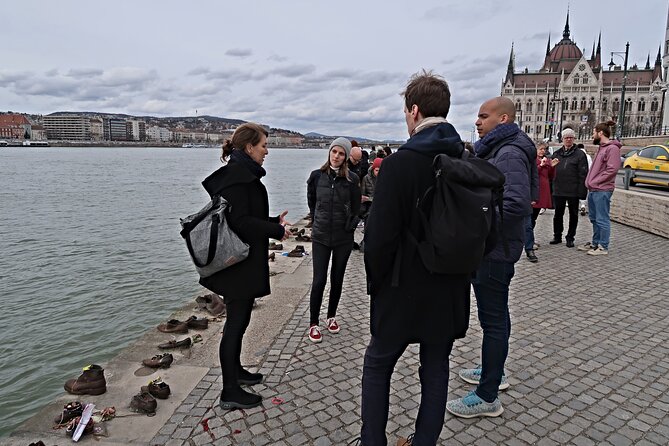
The walk concludes at Shoes on the Danube Bank, one of Budapest’s most powerful memorials. The small iron shoes represent Jewish people murdered at the river during World War II. The memorial is simple, direct, and easy to underestimate until you stand among the individual shoes.
This is a quiet ending rather than a dramatic one. Your guide invites you to reflect on the people who died there and on the rebuilding of Budapest’s Jewish community today. That final turn toward the present is important. The tour does not leave Jewish Budapest frozen in wartime suffering.
The location also gives the walk a wider city setting. You finish at the Danube, away from the synagogue quarter, with the river and central Budapest around you. The change in surroundings helps connect the local story to the city as a whole.
If you want to honor particular Holocaust victims, ask your guide in advance. Endres has provided materials and joined participants in cleaning stumbling stones, a small but meaningful act of remembrance. This is not promised as a standard part of every departure, so treat it as a possible addition rather than an included activity.
The guide can make or break this experience
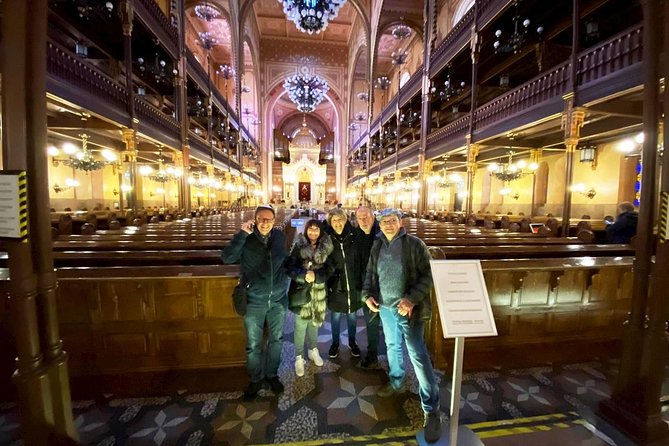
The strongest feature here is the guide. The tour is designed around historians and Jewish Studies scholars, not a recorded commentary or a simple list of dates. The available guides include professors, doctoral students, historians, journalists, art critics, and published authors.
That range means your experience can vary by guide, but the feedback points to a high level of care. Orsolya has been praised for checking with a group before moving to the next stop and for adjusting the pace to suit the people with her. That is helpful on a serious tour, where you may want a little extra time at a memorial or a chance to ask about a difficult subject.
Endres has been praised for exceptionally detailed explanations of the Great Synagogue, the Jewish community, and the Nazi era. His willingness to take part in cleaning stumbling stones also suggests the kind of personal attention that can make this more than a standard sightseeing walk.
The tour is offered in English, with private or small-group formats available. If you choose a private option, you are more likely to shape the conversation around your interests. A small group can also work well if you prefer company without the feel of a large crowd.
Is $123 a fair price?
The price requires a careful calculation. At $123 per person for three hours, this is not a budget walking tour, especially because admission to Dohány Synagogue costs an additional 14,500 forints.
You are paying for a specialist guide, a focused route, and access to historical interpretation that you may not get from a general city walk. For a private group, the value improves if you care about asking questions and setting the pace. For a larger party, the total cost may feel easier to justify when split across the group.
Still, you should not book this expecting a low-cost introduction to Budapest. It is aimed at people who want a serious, guided look at Jewish Budapest and are willing to pay for expert attention. The excellent 4.9 rating from 26 bookings supports the idea that the guiding is the main reason people find the cost worthwhile, but the synagogue ticket remains an extra expense.
Timing, pace, and practical planning
Three hours is enough to cover the main route, but it is not enough for every site to receive a long visit. The Dohány complex receives the most attention, while Kazinczy and Rumbach are discussed from the outside according to the stated route.
Wear comfortable shoes. You will walk between several central Budapest locations, and the tour ends at the Danube rather than returning to the starting cafe. The listed final arrival point is an unnamed road, so confirm the exact end location with the provider if you need to plan a later reservation.
The tour is available at different starting times depending on the date. Since the route includes memorials and religious sites, choose a time that allows you to walk without rushing to another appointment.
You can cancel up to 24 hours in advance for a full refund, and the reserve-now, pay-later option keeps your plans flexible. Those policies are useful, but the bigger planning point is clothing for Dohány and enough time afterward to process the subject matter.
Who should book this walking tour?
I would recommend it to you if you:
- Want Jewish Budapest explained through religious, cultural, and wartime history
- Prefer a historian rather than a general sightseeing guide
- Plan to visit Dohány Synagogue and want help reading its details
- Are comfortable discussing the Holocaust in a thoughtful setting
- Value private or small-group conversation
- Want to see how several Jewish traditions shaped one neighborhood
I would hesitate if you only want a quick photo tour, dislike serious historical discussion, or are trying to keep admission costs low. The route is also less suitable for anyone expecting to enter every synagogue, since Kazinczy and Rumbach are presented from the exterior.
Should you book A Journey Through Jewish Budapest?
Book it if you want meaning as well as monuments. The route moves from Herzl’s birthplace to Dohány’s grand synagogue, then through the Ghetto Wall Memorial, Kazinczy, Rumbach, and finally Shoes on the Danube. That sequence gives you a clear view of Jewish life before the war, the damage caused by persecution, and the community’s continuing presence.
The separate synagogue ticket makes the total price high, so compare the full cost before booking. But if a historian such as Orsolya or Endres leads your group, you are paying for more than walking directions. You are paying for context, conversation, and a careful way to approach places that deserve more than a quick look.
FAQ
How long is the Jewish Budapest walking tour?
The tour lasts three hours.
What language is the tour offered in?
The live tour guide speaks English.
Is the Dohány Synagogue admission included?
No. Individual admission to the Dohány Synagogue is listed at 14,500 Hungarian forints.
What should I wear to the Dohány Synagogue?
Visitors are requested to have their shoulders and knees covered.
Where does the tour begin?
The meeting point is Kamara Café at Dohány utca 1/A. The exact starting location can depend on the option selected.
Is the tour private or shared?
Private and small-group options are available.
Just added in Budapest
- Budapest: Private Walking Tour with a Local Guide★ 3.6 · 6 reviews
- Budapest: Danube River Views Bike Ride★ 4.8 · 23 reviews
- Budapest: City Bike Tour with Coffee Stop★ 5.0 · 37 reviews
- From Budapest: Guided Tour of Eger with Wine Tasting★ 4.5 · 6 reviews
- Walk to recent and aged spiritual sanctuaries near Budapest★ 5.0 · 5 reviews
- Walking consultancy with alternative psychologist and author★ 5.0 · 2 reviews
- Budapest: Guided Tour of the Parliament Building in Spanish★ 4.6 · 1,240 reviews
- True Crime Walking Tour in the Buda Castle district★ 5.0 · 26 reviews
Jewish Heritage Tours, compared.
Budapest Jewish Heritage Memorial Walking Tour & Synagogue Entry
Read our review →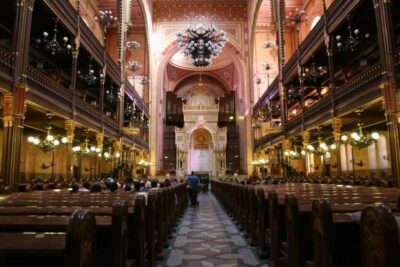
Jewish Heritage Guided Tour with Synagogue Ticket
Read our review →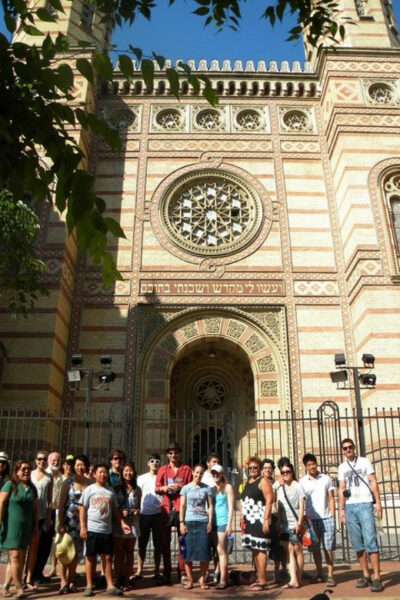
Past and Present of Budapest Jewish District Tour
Read our review →
Budapest Dohany Synagogue & Hungarian Jewish Museum & free extras
Read our review →
Jewish History Guided Walking Tour with Historian
Read our review →Browse the lists this tour appears in