
REVIEW · COMMUNIST HISTORY TOURS
Communist Budapest Private Walking Tour
The past is still built into Budapest. This private walking tour makes the city’s communist era easier to read, linking the 1956 Revolution, Cold War politics, socialist architecture, and daily life under goulash communism. I like the private format, which lets your guide adjust the discussion to your interests, and I like the use of public transport because the sites are spread across the city. The main consideration is the price: at $393.17 per group, it makes the most sense when several people share the cost.
The tour also earns praise for its guides. Andras has been singled out for his warmth, clear explanations, and willingness to shape a longer visit around a group’s interests. Kata is praised for her broad perspective, humor, grace, and clear storytelling. Plan on about three hours, though one reported private visit with Andras lasted four hours, so a little flexibility is wise.
In This Review
- Key points to know before booking
- Why communist Budapest makes a worthwhile walking theme
- Kossuth Square and the opening view of 1956
- Liberty Square, Reagan, and Cold War symbolism
- Bem József Square and the first large protest
- Socialist realism at Puskas Ferenc Stadium
- House of Terror: a strong ending outside the museum
- What the three-hour format really means
- Price, group size, and value
- The guides make the private format work
- Who should book this Budapest history walk?
- Should you book it?
- FAQ
- How long does the Communist Budapest Private Walking Tour last?
- Where does the tour begin?
- Where does the tour end?
- Is admission to the House of Terror Museum included?
- Are metro and tram tickets included?
- Is the tour private?
- Is the tour offered in English?
- Can I cancel for a full refund?
Key points to know before booking
- The 1956 Revolution is central: You visit Kossuth Square and Bem József Square, two places tied to the uprising against Soviet-backed rule.
- It is a city tour, not one museum visit: The route uses the subway, tram, and walking to connect scattered Cold War sites.
- The former secret police headquarters is the endpoint: You finish outside the House of Terror Museum, but entry is not included.
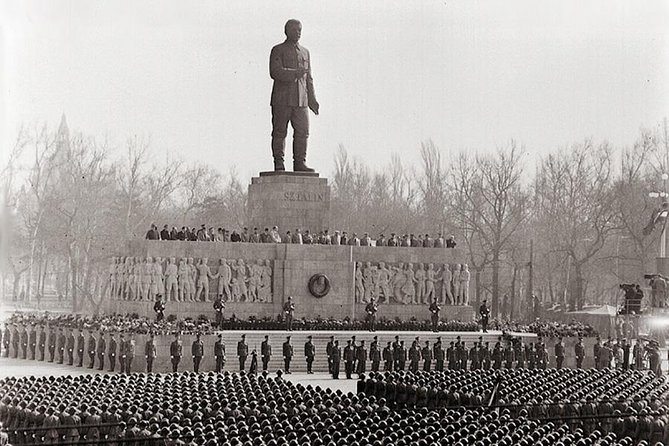
- Socialist public art gets close attention: Puskas Ferenc Stadium preserves imposing statues made to support the regime’s message.
- The price covers a private group: The listed rate is $393.17, with group limits described as up to 10 in one place and up to 8 in another.
- Transport tickets are extra: Your guide helps you buy metro and tram tickets if you do not already have a Budapest transport pass.
Why communist Budapest makes a worthwhile walking theme
Budapest’s communist period lasted from 1949 to 1989, but its traces are not gathered in one neat historic quarter. They appear in government squares, monuments, apartment estates, stadiums, cafés, embassies, and streets once used for official parades.
That scattered geography is exactly why a guide helps. You are not simply looking at old concrete and statues. You are learning how public space was used to project power, how Soviet influence shaped Hungary, and how ordinary people managed shortages and restrictions while the government tried to present a calmer version of communism.
The phrase goulash communism refers to Hungary’s somewhat less rigid system after the 1956 uprising, especially under János Kádár. It did not mean freedom in the modern sense. It did mean that the government tried to maintain public calm through modest consumer comforts and a less openly brutal style than some other communist states.
I like this subject because it moves past easy Cold War symbols. You see Soviet power, but you also hear about the compromises and private frustrations of daily life. The tour is best for anyone who wants political history tied to real streets and buildings, not just dates in a museum.
More communist-era history tours:
- Budapest: Communist History Tour with House of Terror Option
★ 4.8 · 182 reviews - Communism in Hungary with a Historian
★ 5.0 · 70 reviews - Budapest: 3-Hour Walking Tour About Communism (Small Group)
★ 4.7 · 70 reviews
Kossuth Square and the opening view of 1956
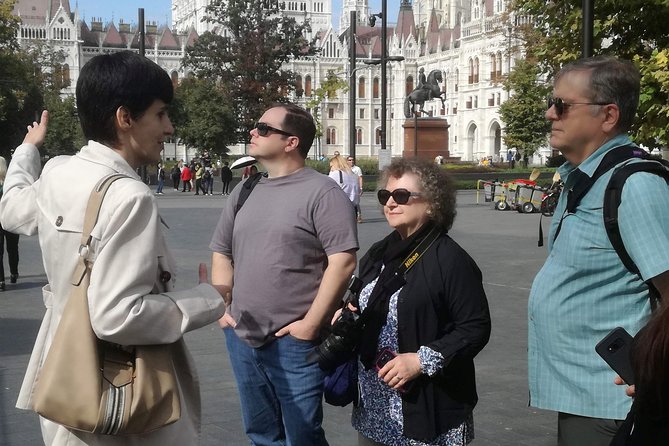
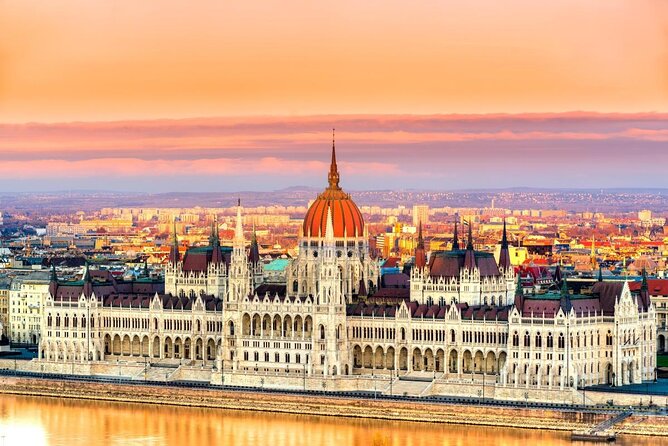
The tour begins with a journey to Kossuth Square, directly in front of the Hungarian Parliament Building. Depending on your hotel and the arrangements made with your guide, you may meet at your central hotel or flat first, then go by metro, tram, or on foot.
Kossuth Square provides a strong opening because it connects Hungary’s formal political center with the 1956 Revolution. Here, your guide discusses monuments linked to the uprising and explains how public demonstrations challenged the communist government and Soviet control.
The Parliament itself is an imposing backdrop, but the focus is not a standard architecture tour. You are looking at the square as a place of political pressure, public memory, and national identity. The roughly 25 minutes here should give you a foundation for the rest of the morning or afternoon.
The practical point is simple: wear shoes suited to walking and urban pavement. This is a moving tour, and the route combines several stops rather than keeping you in one square for a long lecture.
Liberty Square, Reagan, and Cold War symbolism
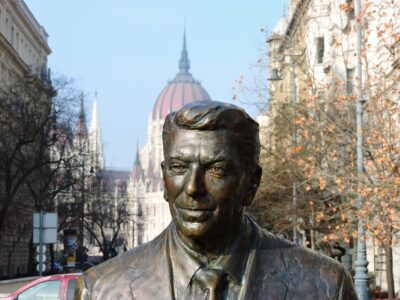
From Kossuth Square, the route continues to Liberty Square. This section brings together several symbols that can feel contradictory at first: the US Embassy, a monument to the Soviet Army, a statue of Ronald Reagan, and an atomic shelter.
That mixture is the point. Your guide uses the square to explain the Cold War from the Hungarian viewpoint, where global power politics were felt in a country living under Soviet influence. The Soviet monument represents the military force that shaped postwar Hungary. The Reagan statue recalls the American president’s opposition to the Iron Curtain and the gratitude many Hungarians feel for his role in challenging Soviet power.
The atomic shelter adds another layer. It reminds you that the Cold War was not only about speeches and borders. People also lived with the fear of a conflict that could reach ordinary city streets.
A guide’s interpretation matters most here. Without context, the square can look like a collection of unrelated monuments. With context, it becomes a compact lesson in how Budapest remembers both foreign domination and outside support.
The Reagan stop itself is brief, around 10 minutes. That is enough for an explanation and some time to look around, but not enough for a long political discussion. If American foreign policy or Cold War diplomacy is your main interest, tell your guide early. The private setup gives you a better chance of shaping the emphasis.
Bem József Square and the first large protest
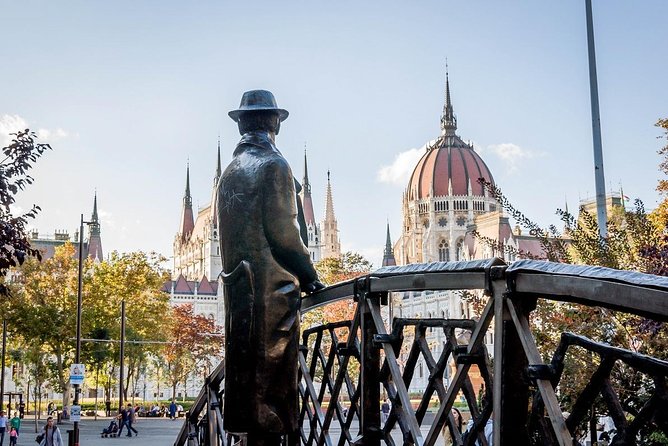
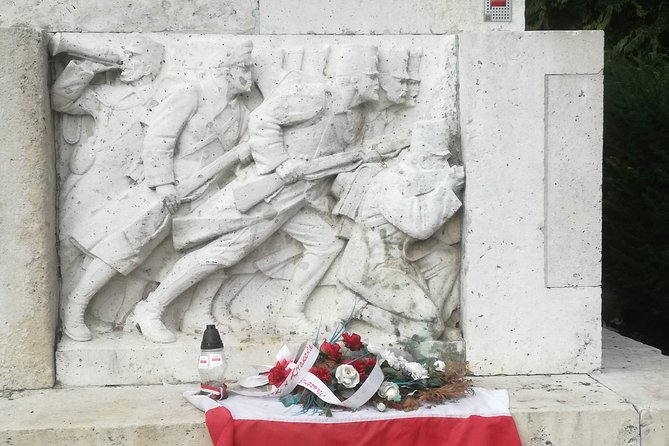
Bem József Square is one of the tour’s most important stops. It was the scene of the first major demonstration of the 1956 uprising, so the square gives the political story a clear starting point.
This is where the tour can feel most connected to the people who lived through the period. Demonstrations begin with bodies in public space, not just official announcements. A crowd gathers, symbols are carried, demands are voiced, and a government suddenly faces a challenge it cannot easily control.
The scheduled visit lasts about 25 minutes. That should allow your guide to explain the square’s role and point out its memorial details without making the stop feel rushed.
There is also a coffeehouse on the square that has kept its original 1960s interior. This is an unusually useful detail. Instead of seeing only political monuments, you get a glimpse of the everyday setting in which people met, talked, waited, and watched the country change around them.
I would ask your guide if the coffeehouse is open during your visit. The tour description identifies it as part of the square, but it does not promise a café stop or reserved seating. Treat it as a visual piece of the story rather than a guaranteed break.
More walking tours in Budapest:
- Budapest: Buda Castle Walk with Saint Stephen’s Hall
★ 4.5 · 3,012 reviews - Big Bus Budapest Hop-On Hop-Off Bus and Walking Tour
★ 3.5 · 2,206 reviews - Budapest: Buda Castle District Walking Tour
★ 4.6 · 2,108 reviews - Budapest City Landmarks Walking Tour in 2 Hours
★ 5.0 · 2,048 reviews
Socialist realism at Puskas Ferenc Stadium
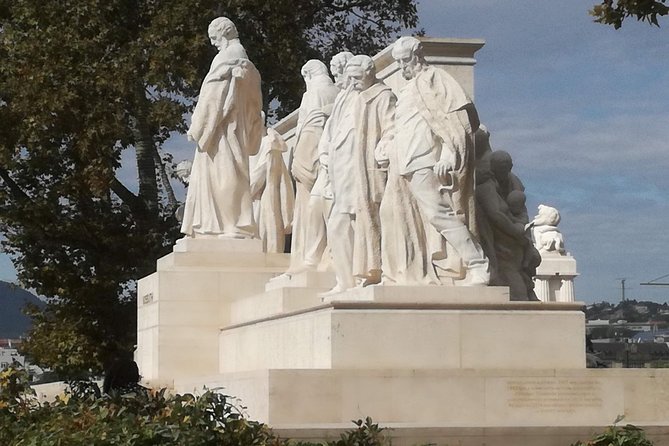
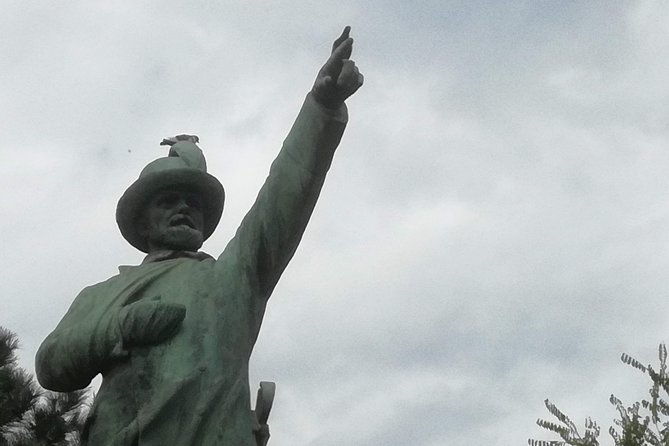
The former People’s Stadium, now Puskas Ferenc Stadium, offers a look at the regime’s visual language. The classic socialist realist statues around the stadium were designed to project strength, discipline, physical health, and loyalty to the state.
The stop lasts about 20 minutes and admission is free. You should not expect a stadium event or an interior sports visit. The point is to examine the public art and understand how propaganda worked through heroic bodies, muscular poses, and carefully chosen civic settings.
This is one of the places where a historian guide can help you notice more than the surface. Socialist realist art was not meant to be subtle. It was meant to teach people what the ideal worker, soldier, athlete, or citizen should look like. The statues also show how the regime used familiar public activities, such as sport, to promote political values.
For some people, this will be the tour’s most memorable visual stop. For others, it may feel less emotionally immediate than the 1956 sites. That difference is worth considering. If you care more about personal stories than architecture and propaganda, tell your guide so the discussion can lean toward daily life and political experience.
House of Terror: a strong ending outside the museum
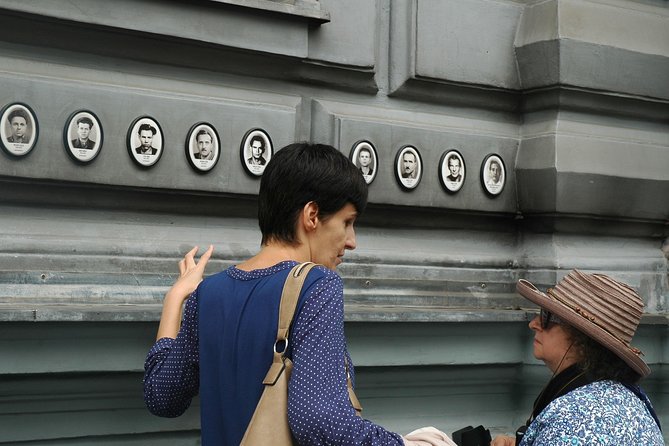
The tour ends outside the House of Terror Museum on Andrássy Avenue. The building once housed communist secret services, and its severe exterior gives the final stop a heavy mood. A section of the Berlin Wall sits in front, linking Hungary’s experience to the wider division of Europe.
The museum itself is not included. That is both a limitation and a useful choice. You pay for a guided outdoor tour, then decide on your own if you want to return and spend more time inside. If you already have a full Budapest schedule, you are not forced into another admission charge. If the Cold War period has caught your attention, the museum gives you a natural next step.
The scheduled discussion outside lasts about 15 minutes. I would not plan a tight appointment immediately afterward. The guide may finish on time, but the tour moves through a series of sites and public transport connections, and one private visit with Andras ran longer than the advertised three hours.
Ending at the House of Terror also gives the route a clear arc. You begin with public revolution and political squares, examine the symbols of state power, and finish at a building associated with surveillance and repression. The tone is serious, but the route is not presented as a parade of grim facts. It is an explanation of how power operated and how Hungary remembers it.
What the three-hour format really means
Three hours is enough for a focused introduction, not a complete study of communist Hungary. You will spend part of the time moving between locations, so the actual discussion at each stop is measured.
That format works well if you want a strong historical framework during a Budapest stay. It also prevents the subject from becoming a long indoor lecture. You keep changing setting, which helps the political story stay connected to physical places.
The route is not a continuous stroll through one compact neighborhood. You may use the metro and tram, with some walking when sites are close together. Tickets are not included, but your guide will help you purchase the required tickets if you do not already have a transport pass.
Pickup is offered from a central hotel or flat. The guide will request your address when sending contact details, including a phone number and photo. If you do not provide an address or prefer not to use pickup, meet at the default starting point 15 minutes before the tour.
The listed start point is Budapest, Frankel Leó út 2-4, in District II. The end point is the House of Terror Museum at Andrássy út 60, in District VI. That one-way arrangement is convenient because you finish at a major museum and central avenue rather than needing to return to your starting point.
Price, group size, and value
The listed price is $393.17 per group, not per person. Shared among six people, that works out to roughly $65.50 each. With eight people, it is about $49.15 each. With the maximum group size, the per-person cost drops further.
That makes the tour much easier to justify for a family or group of friends than for one or two people. A private historian for three hours costs more than a large group city walk, but you are paying for personal attention, a flexible conversation, and a route built around a specific historical subject.
There is a group-size detail you should confirm before booking. The main price information says up to 10 people, while the additional tour details list a maximum of 8 travelers. Since those figures do not match, contact Insight Cities if your party has nine or ten people.
The price does not include entry to the House of Terror or public transport tickets. Those extra costs are small compared with the tour price, but they matter when you are setting a daily budget. The tour is offered in English and confirmation is provided at booking.
The guides make the private format work
The strongest praise focuses on the guides’ teaching style rather than on a single monument. Andras is described as warm, highly informed, and willing to adjust the tour to suit a group’s interests. That flexibility is important here because communist Budapest can be approached through politics, architecture, art, economics, family life, or international relations.
Kata receives praise for explaining things clearly and bringing a broad world view to the discussion. Her humor, grace, and charm also help keep a serious subject pleasant to follow.
You should use that flexibility. At the start, tell your guide if you want more time on the 1956 Revolution, secret police methods, propaganda, housing, Soviet influence, or the end of communism in 1989. A private walk is most valuable when you help shape it.
The tour is suitable for most people, and the sites are near public transportation. Still, it involves walking, standing, and transfers. Anyone who dislikes changing between transport and outdoor stops may prefer a museum-based experience.
Who should book this Budapest history walk?
I would recommend it to you if you want Budapest’s communist period explained by a local historian rather than encountered as a set of isolated monuments. It is especially useful early in your stay, when the guide can give you political context for other parts of the city.
It suits adults, older children, history students, and anyone interested in the Cold War. The private setup is also a good fit for families or friends who want to ask direct questions without keeping pace with a large group.
You may want a different activity if your main goal is to enter the Parliament Building, spend hours inside museums, or see a broad list of Budapest sights. Parliament is a backdrop and meeting point for the first stop, not a tour interior. The House of Terror is viewed from outside unless you arrange a separate museum visit.
Should you book it?
Book this tour if you value clear historical explanation, personal attention, and places tied directly to Hungary’s communist past. The route gives you more than a general city walk, and the praise for Andras and Kata suggests that the quality of the guide is a major part of what you are buying.
The price is fair for a full private group, less so for a solo visitor or couple. Confirm the maximum group size, allow extra time beyond three hours, and decide if you want to visit the House of Terror afterward. If those details suit your plans, this is a thoughtful way to understand the political forces still visible in Budapest’s squares, statues, and streets.
FAQ
How long does the Communist Budapest Private Walking Tour last?
The tour lasts approximately three hours. One private visit with Andras lasted four hours, so you should allow some extra time if your schedule is tight.
Where does the tour begin?
The default meeting point is Budapest, Frankel Leó út 2-4, 1027 Hungary. Pickup is also offered from a central hotel or flat.
Where does the tour end?
The tour concludes outside the House of Terror Museum at Andrássy út 60, 1062 Budapest.
Is admission to the House of Terror Museum included?
No. The tour ends outside the museum, and admission to the interior exhibit is not included.
Are metro and tram tickets included?
No. Public transport tickets are not included. Your guide will help you purchase the needed tickets if you do not already have a transport pass.
Is the tour private?
Yes. It is a private guided walk priced per group. The supplied details list the group limit as up to 10 in one place and a maximum of 8 in another, so larger groups should confirm the limit before booking.
Is the tour offered in English?
Yes. The tour is offered in English.
Can I cancel for a full refund?
Yes, if you cancel at least 24 hours before the local start time. Cancellations or changes made less than 24 hours before the start are not refunded or accepted.
Just added in Budapest
- Budapest: Private Walking Tour with a Local Guide★ 3.6 · 6 reviews
- Budapest: Danube River Views Bike Ride★ 4.8 · 23 reviews
- Budapest: City Bike Tour with Coffee Stop★ 5.0 · 37 reviews
- Walking consultancy with alternative psychologist and author★ 5.0 · 2 reviews
- From Budapest: Guided Tour of Eger with Wine Tasting★ 4.5 · 6 reviews
- Walk to recent and aged spiritual sanctuaries near Budapest★ 5.0 · 5 reviews
- Budapest: Guided Tour of the Parliament Building in Spanish★ 4.6 · 1,240 reviews
- Budapest: 3-Hour Trabant Sightseeing Tour★ 4.7 · 28 reviews
Communist History Tours, compared.
Communist History Tour with House of Terror Option
Read our review →3-Hour Walking Tour About Communism (Small Group)
Read our review →

Lives of Hungarians Under Communist and Capitalist system
Read our review →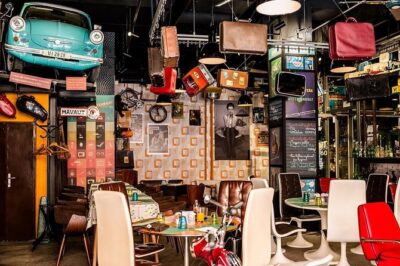
Private Budapest Hammer & Sickle Communist Times Tour
Read our review →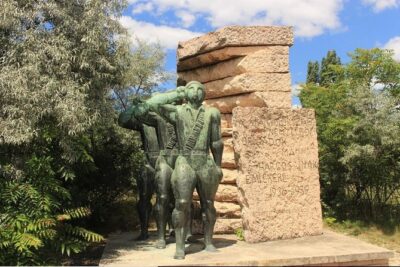
Memento Park Visit with Private Trabant Transfer
Read our review →
Browse the lists this tour appears in