
REVIEW · COMMUNIST HISTORY TOURS
Communist Budapest Walking Tour
The past still shapes Budapest. This three-hour Communist Budapest walking tour connects revolution sites, Cold War symbols, housing blocks, and propaganda art into a clear story of life under Goulash Communism. I especially like the use of old photographs on an iPad and the chance to see parts of the city most standard sightseeing walks skip. The tour also brings history down to street level, showing how modern flats, metro rides, and public monuments fit into everyday life.
I also like that your guide is a historian, professor, doctoral student, journalist, art critic, or published author rather than a general city guide. Andras, one guide praised for his relaxed and conversational manner, adjusted the route around what his group had already seen. The main consideration is the price: at $123 per person, you are paying for a specialist-led private or small-group experience, not a cheap orientation walk. Some travelers with a solid background in Hungarian history may find parts of the explanation too basic.
In This Review
- Key details that shape the experience
- What this Budapest communist history tour helps you understand
- Bem József Square and the first great protest of 1956
- Kossuth Square and the memory of armed conflict
- Freedom Square’s four Cold War symbols
- The 1970s housing estates and the promise of a modern flat
- Puskás Stadium and Socialist Realist statues
- Stalin’s trolley bus route and May Day photographs
- The House of Terror and the final weight of the story
- Is $123 a fair price for three hours?
- Who should book this walk?
- Practical details before you go
- Should you book the Communist Budapest Walking Tour?
- FAQ
- How long does the Communist Budapest Walking Tour last?
- Where does the tour begin?
- What language is the tour offered in?
- Are public transport tickets included?
- Is the tour private or shared?
- What kind of guides lead the tour?
Key details that shape the experience
- 1956 begins at Bem József Square: See where the first large demonstration of the Hungarian uprising took place, then visit a coffeehouse with its original 1960s interior.
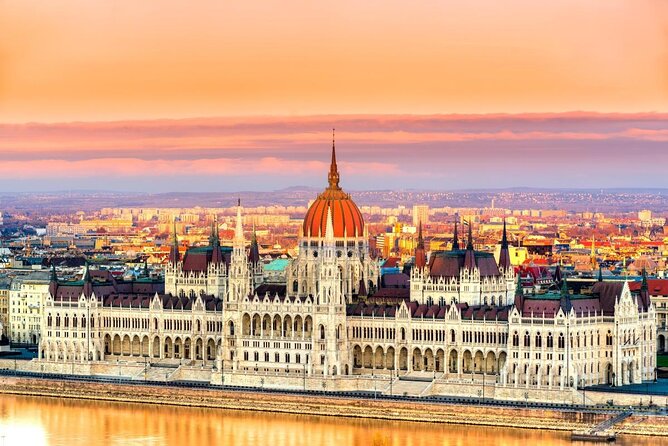
- Kossuth Square connects history to Parliament: Monuments here recall the political and armed conflicts of the 1956 revolution.
- Freedom Square compresses the Cold War into four sights: The U.S. embassy, Soviet army monument, Ronald Reagan statue, and atomic shelter entrance sit close together.
- 1970s housing estates reveal everyday Goulash Communism: The gray apartment blocks once represented prized modern living for young families.
- Puskás Stadium preserves Socialist Realist art: Heroic workers, soldiers, and intellectuals point toward the future imagined by the regime.
- Old photographs make the past visible: Your guide uses an iPad to compare today’s streets with Budapest during the Stalinist period.
What this Budapest communist history tour helps you understand
Budapest’s communist period can be hard to grasp if you only visit grand buildings and memorials. The story is not simply one of oppression followed by freedom. It also includes shortages, compromise, new housing, public transport, mass demonstrations, family life, and limited personal freedoms traded for obedience on major political questions.
That is the idea behind Goulash Communism. After the harshest Stalinist years, Hungary developed a somewhat looser version of state socialism. People could enjoy small comforts and greater personal space than in some other communist countries, but open political opposition remained dangerous. This tour aims to show that contradiction through actual places.
You spend much of the time walking, but the route also uses the metro and a trolley bus. Those rides matter because transport is part of the story. You are not being driven between isolated monuments. You move through ordinary parts of Budapest and see how the city’s public spaces, streets, and housing were shaped by the period.
The three-hour length gives the tour enough room to make connections without turning into a full-day commitment. Still, expect a lot of walking, standing, and historical detail. One review described the pace as relaxed, while another noted feeling tired after the amount of walking and information. Comfortable shoes will help.
More communist-era history tours:
- Budapest: Communist History Tour with House of Terror Option
★ 4.8 · 182 reviews - Communism in Hungary with a Historian
★ 5.0 · 70 reviews - Budapest: 3-Hour Walking Tour About Communism (Small Group)
★ 4.7 · 70 reviews
Bem József Square and the first great protest of 1956
The tour begins at Bambi Eszpresszó, at Frankel Leó út 2/4 in Budapest’s District II, and then heads to Bem József Square. This is a strong starting point because the 1956 uprising began as a public demonstration with demands for political change, national independence, and reform.
The square is not just a backdrop for a lecture. It helps you picture how people gathered, marched, and turned a protest into a national revolt. Your guide can explain why this location mattered and how events moved from peaceful demonstration toward armed conflict.
A coffeehouse with its original 1960s interior adds a useful domestic touch. Instead of keeping the period at the level of leaders and battles, the tour gives you a glimpse of the places where people sat, talked, and spent ordinary time. The preserved interior is particularly useful for understanding the mood of the era, even if you are not interested in café design.
This first stop also sets the tone for the whole walk. You will hear about major political events, but you will also see how the period appeared in daily life. If you already know the basic 1956 story, ask your guide to focus on local details, family life, or the political changes after the uprising.
Kossuth Square and the memory of armed conflict
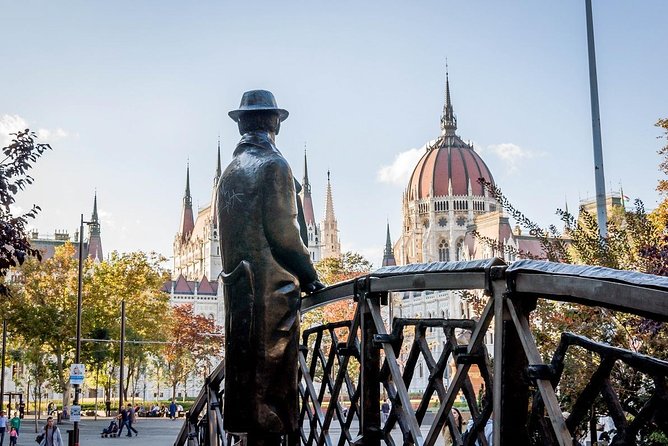
From Bem József Square, you take the metro to Kossuth Square, in front of Parliament. Metro tickets are not included, so you need to budget separately for public transport. That small extra cost is easy to overlook, but the metro ride is part of the practical rhythm of the tour.
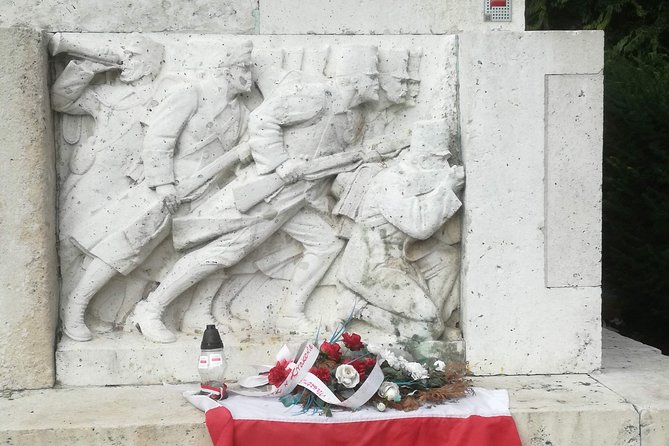
Kossuth Square is one of the most important political spaces in Budapest. During the 1956 revolution, it became the site of major events, including political and armed conflict. The monuments here help preserve memories of those clashes and the people affected by them.
Your guide’s job at this point is to separate the physical setting from the simplified version of the past. Parliament can make the square feel ceremonial and polished today. The tour asks you to picture it as a place of tension, uncertainty, and public confrontation.
This is one of the stops where a specialist guide can add real value. A casual city walk may point out Parliament and move on. Here, the building and square become part of a larger explanation about power, public protest, and the limits of reform under a one-party system.
If your previous Budapest sightseeing has focused on architecture, Kossuth Square gives you a different way to read the city. The question is not only what a building looks like, but who controlled the space, who could speak there, and what happened when people challenged authority.
Freedom Square’s four Cold War symbols
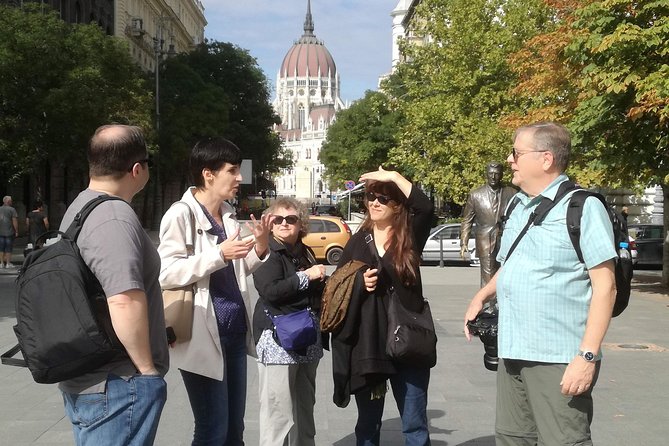
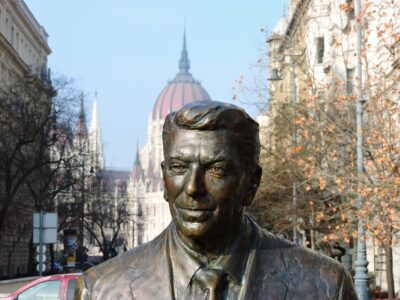
A short walk takes you to Freedom Square, where four very different structures bring the Cold War into one compact area. You see the U.S. embassy, a monument to the Soviet army, a statue of President Ronald Reagan, and the entrance to a secret atomic shelter.
The combination is unusual. The square does not offer one tidy political message. Instead, it places competing memories and symbols near one another. The Soviet monument points to the military and political power that shaped Hungary after World War II. The American embassy represents the Western power that many Hungarians looked toward, even when direct support was limited or impossible.
The Ronald Reagan statue adds a later political memory. The atomic shelter entrance reminds you that Cold War fear was not abstract. Governments prepared for possible nuclear conflict, and ordinary city spaces could have a hidden purpose beneath them.
I find this section especially useful because it shows how Budapest remembers the period in layers. A monument can honor one side, criticize another, or become part of a new national conversation years later. You may not spend a long time at each structure, but together they make a strong visual lesson.
The square also gives you a break from the more detailed events of 1956. You can look at the city around you and consider how the Cold War was experienced through diplomacy, military presence, political allegiance, and fear of nuclear attack.
More walking tours in Budapest:
- Budapest: Buda Castle Walk with Saint Stephen’s Hall
★ 4.5 · 3,012 reviews - Big Bus Budapest Hop-On Hop-Off Bus and Walking Tour
★ 3.5 · 2,206 reviews - Budapest: Buda Castle District Walking Tour
★ 4.6 · 2,108 reviews - Budapest City Landmarks Walking Tour in 2 Hours
★ 5.0 · 2,048 reviews
The 1970s housing estates and the promise of a modern flat
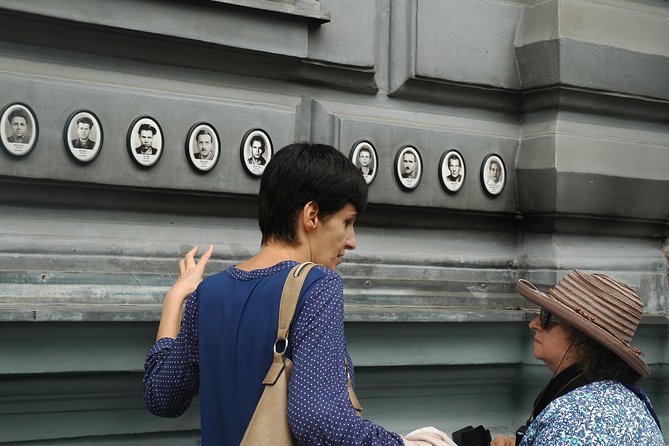
The tour then uses the metro to reach one of the housing estates built at the edge of the city center during the 1970s. These blocks may look plain or gray now, but that reaction can be misleading. When they were new, many young Hungarian families were delighted to receive an apartment there.
The reason was simple. Older Budapest buildings often lacked elevators and modern conveniences. A new apartment in a planned housing estate could offer amenities that seemed like a major improvement: more functional living space, better services, and a modern setting for family life.
This is an important correction to the usual picture of communism. Political control and shortages were real, but so was material progress for some people. The housing blocks tell you why the system could gain a measure of acceptance even while denying political freedom. A family might dislike the regime yet feel grateful for a new home.
You will not be looking at a romantic version of these estates. Their plain design and large scale can feel bleak today. The value comes from learning how their appearance changed over time, from a symbol of progress to a reminder of a worn public building program.
This stop is also one of the tour’s best chances to think about class and age. A young couple starting a family in the 1970s could see the same building very differently from a visitor arriving decades later. Your guide can help you read the estate as a lived neighborhood rather than a row of anonymous concrete blocks.
For me, this part makes the tour more than a political history lesson. You begin to understand why people made practical compromises with the state and why memories of the period can be mixed.
Puskás Stadium and Socialist Realist statues
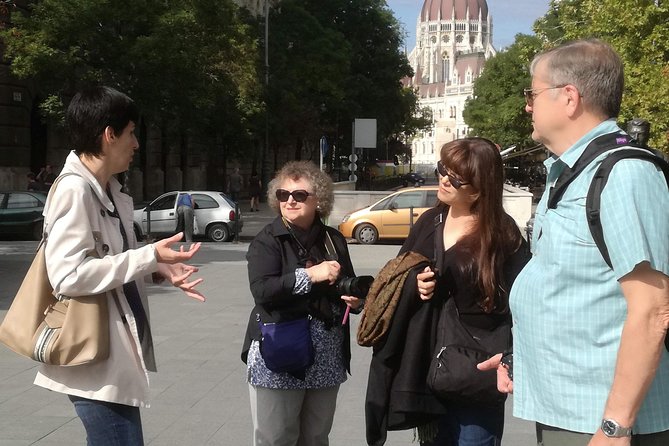
At the former People’s Stadium, now Puskás Soccer Stadium, the tour turns to public art and propaganda. This is one of the few places in Budapest where you can see typical Socialist Realist statues of heroic workers, soldiers, and intellectuals.
The figures are designed to look strong, purposeful, and certain. They point toward a bright future shaped by labor, discipline, education, and loyalty to the state. Their scale and poses tell you what kind of citizen the system wanted to celebrate.
It is easy to dismiss this art as stiff or outdated. Your guide can make it more useful by explaining how the statues worked in their original setting. They were not simply decorations. They helped fill public spaces with a specific political vision.
The former People’s Stadium also shows how sports served public life under communism. A stadium could be a place for football, mass gatherings, official celebrations, and state display. The setting links culture, physical strength, national pride, and political messaging.
This stop is likely to appeal to you if you enjoy architecture, sculpture, or visual clues. It also provides a welcome change from reading plaques and discussing dates. The statues communicate quickly, even before your guide explains their meaning.
Stalin’s trolley bus route and May Day photographs
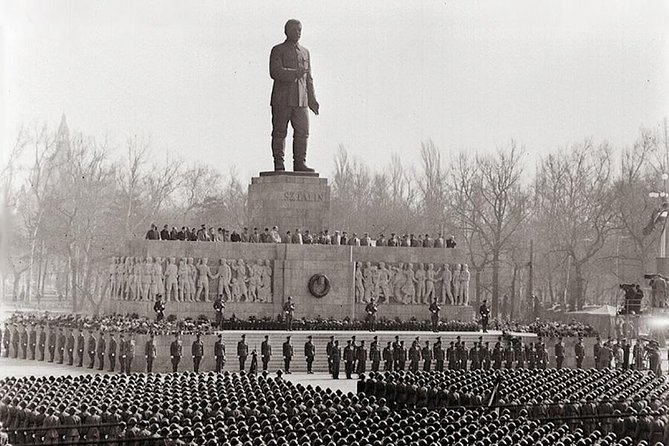
Next comes a short ride on one of Stalin’s trolley buses to Dózsa György Street. Public transport tickets are not included, so keep that in mind when planning the tour budget.
The trolley bus itself gives the route a distinctly local feel. You are using an old form of city transport while discussing the huge May Day parades that once moved along this broad boulevard. The contrast between today’s traffic and the earlier political spectacles is part of the experience.
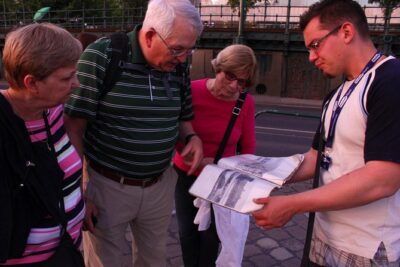
Your guide uses an iPad and old photographs to show how the street looked during Stalin’s time. This visual comparison is one of the tour’s most effective tools. A historical photograph can reveal banners, crowds, statues, uniforms, and building changes that are difficult to reconstruct from words alone.
The photographs also help you see propaganda as a public performance. May Day parades were not just festive events. They displayed loyalty, organized workers into a single mass, and presented the state’s version of progress.
The tour’s pace matters here. You get a short ride and a focused explanation rather than a long museum visit. If you learn best through images, this may be one of the strongest sections. If you want detailed discussion of the fall of communism after 1968, tell your guide early, since one past participant felt the political transition received less attention than expected.
The House of Terror and the final weight of the story
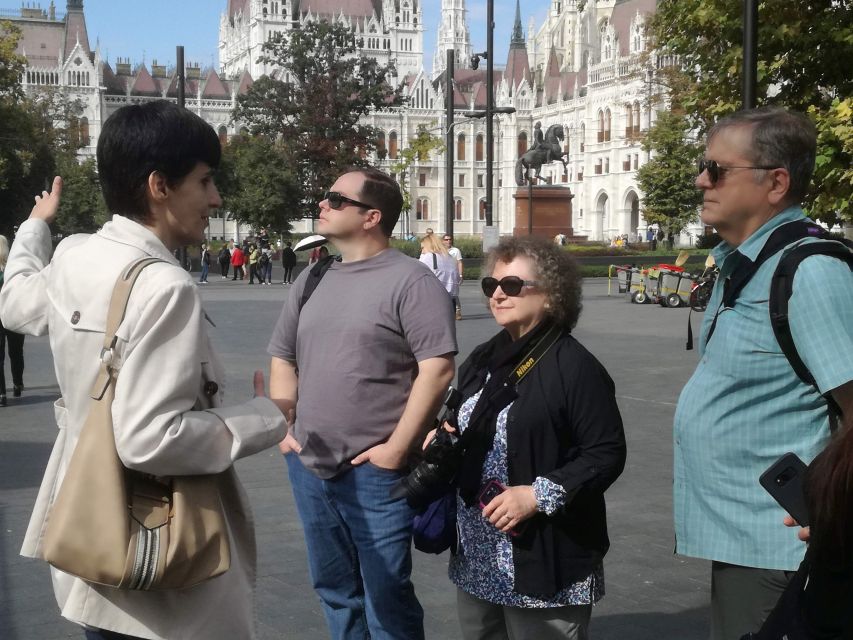
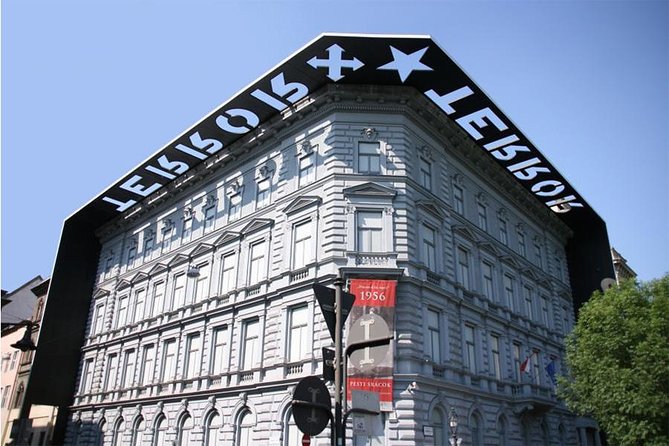
The final major stop is the House of Terror, located in the former headquarters of Hungary’s secret services. The museum commemorates crimes committed under both fascist and communist rule, with particular attention to the Stalinist years.
The exterior itself carries historical weight. In front of the building is a slab of the Berlin Wall, a physical reminder that the political division of Europe was real and built into everyday life. You may not have time for a full museum visit as part of the three-hour route, but the guide can explain why the building matters and how it fits the broader story.
This is a serious ending. The tour begins with public protest and ends at a place connected with surveillance, imprisonment, and state violence. That arc prevents the housing and transport sections from becoming too comfortable. The modern apartment block may have offered real benefits, but those benefits existed inside a system that punished dissent.
If you want to visit the House of Terror museum itself, ask about timing before booking or plan a separate visit. The supplied tour details identify the building as a stop, but they do not promise museum admission or a full interior tour. Treat it as a landmark and historical conclusion unless your guide confirms otherwise.
Is $123 a fair price for three hours?
At $123 per person, this is expensive compared with a standard group walking tour. The price makes more sense if you want a private or small-group setting and a guide with academic or professional credentials.
You are paying for more than a route between monuments. The tour includes a historian guide and uses metro and trolley bus rides to connect locations that are spread across Budapest. The old photographs, specialist subject, and discussion of daily life add value that a basic self-guided walk may not provide.
The value is strongest for first-time learners who want a structured introduction to Hungary between the end of World War II and 1989. The tour gives you a framework for later visits to museums, memorials, and political sites.
The value is less certain if you already know the period well. One three-star assessment found the guide well informed but too close to the basics, with few details remembered the next day. That is a fair warning. The tour appears to depend heavily on the guide and on how actively you shape the conversation.
Ask for the guide to adapt the discussion if you have already seen the main sights or studied Hungarian history. Andras was praised for doing exactly that, changing the emphasis around what the group knew and had already visited.
Who should book this walk?
I would recommend it most strongly to you if:
- You know little about Hungary’s communist period.
- You want political history tied to streets, transport, housing, and public art.
- You prefer a private or small-group setting.
- You enjoy asking questions and comparing past and present.
- You want an academic guide rather than a broad city introduction.
You may want another option if you have already taken detailed communist history tours in Prague or Berlin and expect the same dramatic story. Hungary’s path from dictatorship to democracy was often gradual rather than openly revolutionary, and the tour itself recognizes that difference.
You should also be ready for a serious subject and a fair amount of walking. This is not a light sightseeing loop with a few old buildings. It asks you to think about how people lived with restrictions, why some accepted limited freedoms, and how political symbols shaped public space.
Practical details before you go
The meeting point is Bambi Eszpresszó, Frankel Leó út 2/4, 1027 Budapest. The tour lasts three hours and is offered in English with a live guide.
Metro and trolley bus tickets are not included. Bring enough time and energy for several walking sections, two metro journeys, and a short trolley bus ride. Since the schedule can vary, check the available start times when you choose your date.
The tour offers free cancellation up to 24 hours before the start, and you can reserve now and pay later. Those policies are useful if your Budapest plans are still shifting.
The overall rating is 4.9 from six reviews. The strongest praise goes to the historians and to the relaxed, adaptable style of the guiding. The clearest criticism is that some explanations may feel basic for people who already know Hungary’s modern history.
Should you book the Communist Budapest Walking Tour?
Book it if you want Budapest’s communist past explained through actual places rather than dates alone. Bem József Square, Kossuth Square, Freedom Square, the housing estates, Puskás Stadium, and the House of Terror create a varied route with strong visual contrasts.
At $123, I would choose it for a private or small-group trip, especially if you can ask for a guide who will match the discussion to your background. I would skip it if you want a low-cost general walk or already have a detailed understanding of Hungary from 1945 to 1989.
For the right audience, the tour’s best lesson is also its most honest one: life under communism was neither simple misery nor easy comfort. Budapest’s squares, flats, statues, and transport lines show how those realities existed side by side.
FAQ
How long does the Communist Budapest Walking Tour last?
The tour lasts three hours.
Where does the tour begin?
It begins at Bambi Eszpresszó, Frankel Leó út 2/4, 1027 Budapest, Hungary.
What language is the tour offered in?
The live tour is offered in English.
Are public transport tickets included?
No. Tram and metro tickets are not included in the tour price.
Is the tour private or shared?
Private and small-group options are available.
What kind of guides lead the tour?
Guides include professors, doctoral students, historians, journalists, art critics, and published authors.
Just added in Budapest
- Budapest: Private Walking Tour with a Local Guide★ 3.6 · 6 reviews
- Budapest: Danube River Views Bike Ride★ 4.8 · 23 reviews
- Budapest: City Bike Tour with Coffee Stop★ 5.0 · 37 reviews
- From Budapest: Guided Tour of Eger with Wine Tasting★ 4.5 · 6 reviews
- Walk to recent and aged spiritual sanctuaries near Budapest★ 5.0 · 5 reviews
- Walking consultancy with alternative psychologist and author★ 5.0 · 2 reviews
- Budapest: Guided Tour of the Parliament Building in Spanish★ 4.6 · 1,240 reviews
- Budapest: 3-Hour Trabant Sightseeing Tour★ 4.7 · 28 reviews
Communist History Tours, compared.
Communist History Tour with House of Terror Option
Read our review →3-Hour Walking Tour About Communism (Small Group)
Read our review →

Lives of Hungarians Under Communist and Capitalist system
Read our review →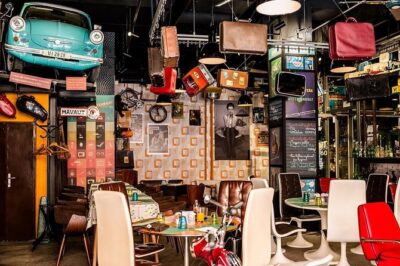
Private Budapest Hammer & Sickle Communist Times Tour
Read our review →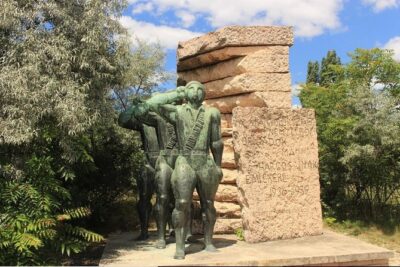
Memento Park Visit with Private Trabant Transfer
Read our review →
Browse the lists this tour appears in